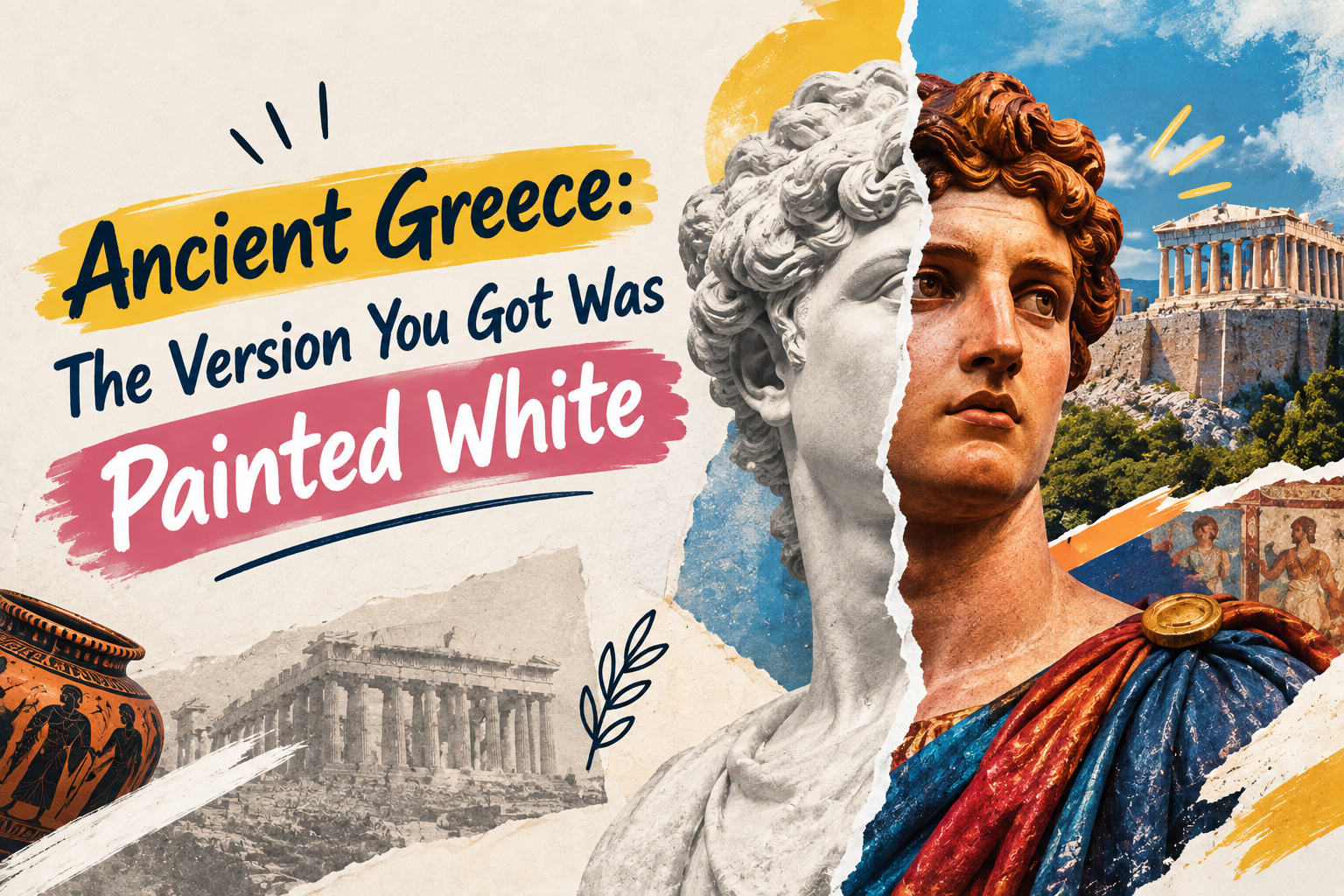
Ancient Greece: The Version You Got Was Painted White
Ancient Greece reaches us as a colour scheme: white marble, blue sea, clean geometry. Almost every part of that image has been tidied up somewhere between then and now.
The statues were not white
Start with the marble. Greek and Roman statues were originally painted in bright, sometimes garish colour — skin tones, coloured robes, painted eyes. The paint wore away over two thousand years, leaving bare stone, and Renaissance and later European artists mistook that faded state for the intended look. The pure-white classical ideal is, essentially, a misunderstanding that hardened into taste.
The 300 were not 300
At Thermopylae in 480 BC, the famous stand against the Persian army was not made by three hundred Spartans alone. They were the elite core, but they fought alongside thousands of other Greeks — Thespians and Thebans among them — who tend to vanish from the retellings entirely. The Spartans got the legend; the allies who died beside them got edited out.
Sparta is over-simplified in the other direction too. Its girls were educated and trained physically, and Spartan women had noticeably more freedom and property rights than women in supposedly enlightened Athens.
Democracy, with an asterisk
Athens invented democracy — demos (the people) plus kratos (power) — around 508 BC. It was also direct rather than representative: citizens voted on matters themselves rather than electing someone to do it for them.
But "the people" was a narrow category. Women could not vote. Enslaved people, who made up a large part of the population, could not vote. Foreigners, however long resident, could not vote. The share of adults who actually held the franchise was small. It was a genuine and radical invention, and it excluded most of the humans standing in the city — both things are true.
A leftover for the quiz: the Greek word idiotes meant a private citizen who took no part in public life. It is where "idiot" comes from — a small, sharp comment on what the Athenians thought of people who ignored politics.
The teachers of everyone
The philosophy runs in a neat chain. Socrates taught Plato; Plato taught Aristotle; Aristotle tutored Alexander the Great. That is roughly a century of Western thought and one world-conquering student in a single lineage.
Socrates himself wrote nothing down — everything we have comes through his students, chiefly Plato, which means the most famous philosopher in history is known entirely at second hand. He was ultimately tried and sentenced to death by that same Athenian democracy, by drinking hemlock, which complicates the tidy story about Athens and free thought.
The Games
The Olympic Games began at Olympia in 776 BC, held every four years in honour of Zeus, and ran for roughly a thousand years before being suppressed. The athletes competed nude — the word "gymnasium" comes from the Greek for "naked" — and winners received a wreath of olive leaves rather than money. The modern revival in 1896 kept the four-year rhythm and quietly dropped the rest.
As with Egypt and Rome, the real Greece is more crowded, more coloured-in, and more contradictory than the marble version. Which is exactly what makes it worth a second look.