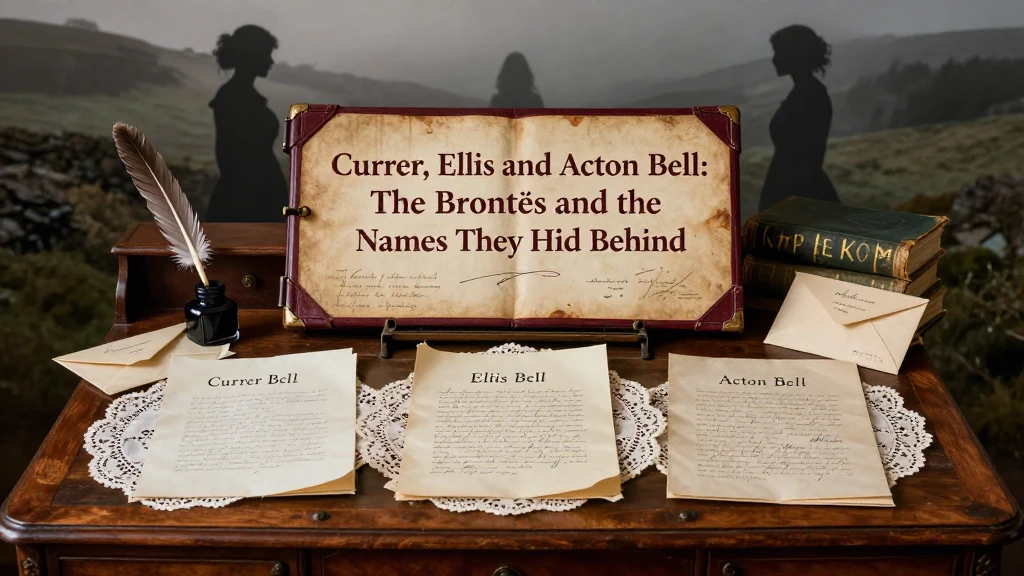
Currer, Ellis and Acton Bell: The Brontës and the Names They Hid Behind
In 1846, a slim volume of poems appeared in London under the names Currer, Ellis and Acton Bell. In its first year it sold, by most accounts, two copies.
The Bells were Charlotte, Emily and Anne Brontë, three sisters living in a parsonage in Haworth, on the edge of the Yorkshire moors. The initials matched their own. The surname did not, and the first names were chosen precisely because a reader could not tell what they were — not obviously male, but certainly not female.
A Childhood of Loss and Imagination
Their father, Patrick Brontë, was an Irish-born clergyman. Their mother died in 1821, when the children were very young, and the two eldest sisters, Maria and Elizabeth, died in 1825 after falling ill at a harsh boarding school. Charlotte later turned that school into Lowood in Jane Eyre.
The surviving children — Charlotte, Branwell, Emily and Anne — invented whole imaginary kingdoms to escape into. Charlotte and Branwell wrote about Angria; Emily and Anne created Gondal. They filled tiny handmade books with stories, written in script so small it needs a magnifying glass to read. It was an extraordinary apprenticeship.
Why Not Their Own Names
Charlotte explained it later, and her explanation is worth giving in spirit if not in full: they had a vague impression that women who wrote were looked on with prejudice, that critics used the author's sex as a weapon, praising with condescension or attacking with a personal edge. So they chose names that gave nothing away.
She was right to worry. When Jane Eyre became a sensation in 1847 and rumours spread that "Currer Bell" might be a woman, a section of the criticism curdled immediately — the book was suddenly coarse, unfeminine, improper.
The Extraordinary Year
What happened next is one of the odder facts in literary history. Within a few months in 1847, the same household produced Jane Eyre (Charlotte), Wuthering Heights (Emily) and Agnes Grey (Anne). Anne followed with The Tenant of Wildfell Hall in 1848 — a novel about a woman fleeing an alcoholic husband, frank enough that Charlotte later prevented it from being republished.
These are not three versions of the same book. Jane Eyre is a first-person account of a governess who refuses to be diminished. Wuthering Heights is a violent, structurally strange, almost pitiless novel that readers still argue about. The Tenant of Wildfell Hall is closer to social realism, and angrier than either.
The Short Ending
The household was struck by tragedy again. Branwell died in September 1848. Emily died that December, and Anne in May 1849, at the seaside town of Scarborough, where she is buried — the only one of the family not buried at Haworth. Emily left just one novel.
Charlotte outlived them all. She kept the name Currer Bell for her later novels, Shirley (1849) and Villette (1853), even as her identity became an open secret in literary London. She married her father's curate, Arthur Bell Nicholls, in 1854 and died the following year, aged 38, while pregnant. Her friend Elizabeth Gaskell's The Life of Charlotte Brontë (1857) told the family's story to the world.
Facts to Remember
- Currer Bell = Charlotte; Ellis Bell = Emily; Acton Bell = Anne.
- Jane Eyre, Wuthering Heights and Agnes Grey were all published in 1847.
- Their home, the Haworth parsonage, is now the Brontë Parsonage Museum.
The whole body of work — the poems, the seven novels — was written and finished in under a decade by three women in their twenties and thirties who had almost no expectation of being read. The pen names were a defence against a world that would not take them seriously. The novels turned out not to need the protection.
Test your knowledge of classic authors in the free World Literature quiz.