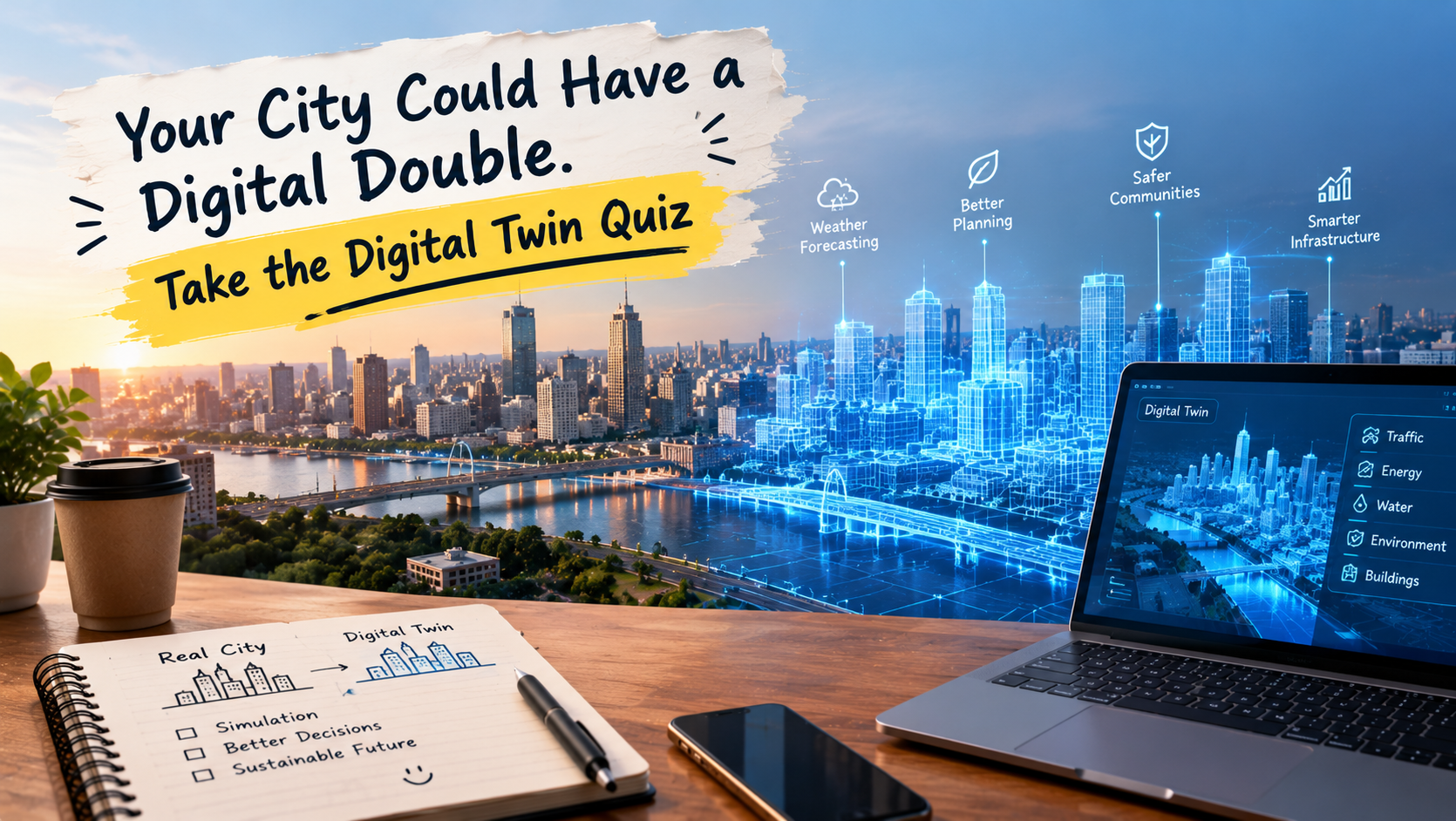
Your City Could Have a Digital Double. Take the Digital Twin Quiz
Your City Could Have a Digital Double. Take the Digital Twin Quiz
Imagine being able to test a change to a building, predict when a machine might need maintenance, or see how a city could respond to heavier traffic—all before making the change in the real world.
That is the idea behind a digital twin. It is a digital representation of a real-world object, process or system that can be connected to data from its physical counterpart. Depending on how it is designed, it may help people monitor performance, run simulations, identify problems and compare possible decisions.
Digital twins are being explored in areas such as manufacturing, energy, transport, construction and healthcare. But the term can sound more complicated than it needs to be, and not every 3D model or simulation qualifies as a digital twin.
Ready to find out how much you know? Try these 50 questions, check each answer and discover where digital twins are already making a difference.
The Digital Twin Quiz: 50 Questions
1. What is a digital twin?
A. A second physical machine kept in storage
B. A digital representation of a real-world object, process or system
C. A computer that can only run two programs
D. A backup copy of an email account
Answer: B. A digital representation of a real-world object, process or system.
Explanation: A digital twin represents a physical asset or system digitally. Depending on its purpose, it may use data from the real world to help monitor or analyse performance.
2. Which of these could have a digital twin?
A. A wind turbine
B. A factory production line
C. A building
D. All of the above
Answer: D. All of the above.
Explanation: Digital twins can represent individual assets, connected equipment, buildings, industrial processes and even larger systems.
3. What makes a digital twin different from an ordinary static 3D model?
A. It must always be colourful
B. It can be connected to real-world data and updated to reflect the system it represents
C. It can only be viewed on a phone
D. It must contain a video game
Answer: B. It can be connected to real-world data and updated to reflect the system it represents.
Explanation: A static model may show how something looks. A digital twin can go further by incorporating operational data, models or simulations to support ongoing analysis.
4. What is a common purpose of a digital twin in manufacturing?
A. To replace every worker automatically
B. To monitor equipment and improve production decisions
C. To print product labels only
D. To remove the need for quality checks
Answer: B. To monitor equipment and improve production decisions.
Explanation: Manufacturers can use digital twins to study production performance, investigate bottlenecks and explore possible process improvements.
5. Which technology can supply live information to a digital twin?
A. Sensors installed on physical equipment
B. A paper notebook alone
C. A decorative wall poster
D. An unplugged keyboard
Answer: A. Sensors installed on physical equipment.
Explanation: Sensors can collect measurements such as temperature, vibration, pressure or energy use. Connected systems can send those measurements to a digital representation.
6. What is the role of the Internet of Things (IoT) in many digital twin systems?
A. It connects physical devices that collect and exchange data
B. It guarantees that all predictions are correct
C. It turns digital files into physical objects
D. It prevents all equipment failures
Answer: A. It connects physical devices that collect and exchange data.
Explanation: IoT devices and networks can help provide the data needed to monitor a physical asset or process.
7. Why might engineers create a digital twin of a wind turbine?
A. To change the weather around it
B. To monitor performance and help identify maintenance needs
C. To generate wind indoors
D. To remove the turbine's physical blades
Answer: B. To monitor performance and help identify maintenance needs.
Explanation: Data about a turbine's operation can help engineers analyse performance, spot unusual patterns and plan maintenance.
8. What does predictive maintenance aim to do?
A. Schedule every repair at random
B. Use data to estimate when equipment may need attention
C. Wait for every machine to fail before inspecting it
D. Replace maintenance workers with a single sensor
Answer: B. Use data to estimate when equipment may need attention.
Explanation: Predictive maintenance uses evidence such as operating conditions and equipment history to help anticipate potential problems.
9. How can a digital twin help with testing a new factory layout?
A. By allowing engineers to model possible layouts before changing the real factory
B. By physically moving machinery through a screen
C. By guaranteeing that production will never stop
D. By eliminating the need for measurements
Answer: A. By allowing engineers to model possible layouts before changing the real factory.
Explanation: Simulations can help teams compare layouts, material flows and possible bottlenecks before investing in physical changes.
10. Does every digital twin need artificial intelligence?
A. Yes, without exception
B. No, some use data, engineering models and simulations without AI
C. Yes, but only if it represents a building
D. No, because digital twins cannot use data
Answer: B. No, some use data, engineering models and simulations without AI.
Explanation: AI can add useful capabilities, but it is not a required component of every digital twin.
11. What is a simulation?
A. A representation of how a system may behave under specified conditions
B. A physical copy of an entire city
C. A permanent guarantee of future events
D. A type of internet cable
Answer: A. A representation of how a system may behave under specified conditions.
Explanation: Simulations use models and assumptions to explore possible outcomes. Their usefulness depends on how well those models represent the real system.
12. Can a digital twin be used to simulate a change before it happens?
A. Yes, if the model supports the relevant scenario
B. No, digital twins can only record past events
C. Only if the real object is destroyed first
D. Yes, and the outcome is always guaranteed
Answer: A. Yes, if the model supports the relevant scenario.
Explanation: Teams can use a suitable digital twin to explore what-if scenarios. The results are estimates based on the model, data and assumptions.
13. What is a digital twin of a building useful for?
A. Monitoring systems such as heating, ventilation and energy use
B. Making the building physically invisible
C. Changing the building's location on Earth
D. Removing every maintenance requirement
Answer: A. Monitoring systems such as heating, ventilation and energy use.
Explanation: Building digital twins can combine information about equipment, spaces and operations to support maintenance, energy management and planning.
14. What could a digital twin of a city help planners investigate?
A. Possible traffic patterns and infrastructure changes
B. The exact thoughts of every resident
C. Future events with perfect certainty
D. The private conversations of every household
Answer: A. Possible traffic patterns and infrastructure changes.
Explanation: City-scale models can help explore transport, infrastructure and planning scenarios. They cannot perfectly predict every person's behaviour or every future event.
15. What is one potential benefit of using a digital twin before building a bridge?
A. Exploring design and performance scenarios before construction
B. Removing the need for structural engineering
C. Guaranteeing that no inspection will ever be needed
D. Making all construction materials free
Answer: A. Exploring design and performance scenarios before construction.
Explanation: Digital models and simulations can support design analysis, but they do not replace engineering standards, physical testing where required or professional review.
16. What does real-time data mean in a connected digital twin?
A. Information that is updated with little delay relative to the use case
B. Information that can never change
C. Data collected only a century ago
D. A fictional number chosen for decoration
Answer: A. Information that is updated with little delay relative to the use case.
Explanation: Real-time requirements vary by application. Some systems need rapid updates, while others can work with periodic measurements.
17. What is one reason a digital twin might not match the physical system perfectly?
A. Its data or model may be incomplete or inaccurate
B. All physical systems are perfectly predictable
C. Digital models cannot contain measurements
D. Every sensor produces identical readings forever
Answer: A. Its data or model may be incomplete or inaccurate.
Explanation: Measurement errors, missing data, changing conditions and simplifying assumptions can all cause differences between a model and the real world.
18. What is a sensor's main job in a digital twin system?
A. To measure a physical condition
B. To make all engineering decisions independently
C. To guarantee that a machine will never break
D. To turn a model into a building
Answer: A. To measure a physical condition.
Explanation: Sensors measure quantities such as temperature, pressure, movement or vibration. Other software processes and interprets the readings.
19. What does calibration help ensure?
A. That a measuring instrument's readings are checked against suitable reference standards
B. That the device becomes wireless automatically
C. That all future data is correct without exception
D. That a digital twin no longer needs updates
Answer: A. That a measuring instrument's readings are checked against suitable reference standards.
Explanation: Calibration helps establish the relationship between an instrument's readings and reference values. It does not eliminate every possible source of error.
20. Which type of data could help monitor a machine's condition?
A. Vibration measurements
B. The colour of the office curtains only
C. The owner's favourite film
D. The number of pages in a novel
Answer: A. Vibration measurements.
Explanation: Changes in vibration can sometimes indicate wear, imbalance or other equipment issues when interpreted with appropriate context.
21. What is a virtual commissioning process?
A. Testing control logic or system behaviour in a virtual environment before or alongside physical commissioning
B. Sending a virtual postcard to a factory
C. Replacing every machine with a video
D. Installing equipment without checking it
Answer: A. Testing control logic or system behaviour in a virtual environment before or alongside physical commissioning.
Explanation: Virtual commissioning can help identify problems in automation and control systems before changes are made to the physical production environment.
22. What is one use of digital twins in aviation?
A. Supporting analysis of aircraft components and maintenance needs
B. Changing the Earth's gravity
C. Replacing every pilot with a digital picture
D. Guaranteeing that turbulence never occurs
Answer: A. Supporting analysis of aircraft components and maintenance needs.
Explanation: Digital models and operational data can help aviation teams analyse component performance and plan maintenance, subject to strict safety requirements.
23. How could a digital twin help manage a power plant?
A. By helping monitor equipment and evaluate operating scenarios
B. By creating unlimited electricity from nothing
C. By removing all safety procedures
D. By making fuel quality irrelevant
Answer: A. By helping monitor equipment and evaluate operating scenarios.
Explanation: Digital twins can support operations and maintenance by combining engineering models with information about how equipment is performing.
24. What might a digital twin of a wind farm represent?
A. Only the colour of the turbines
B. Turbines, their performance and relevant operating conditions
C. The private lives of nearby residents
D. Every future weather event with certainty
Answer: B. Turbines, their performance and relevant operating conditions.
Explanation: A wind-farm digital twin may combine asset models, weather information and operating data to help analyse energy production and maintenance.
25. Why is data quality important in a digital twin?
A. Poor-quality data can lead to misleading analysis or predictions
B. Data quality affects only the colour of charts
C. Accurate data removes the need for a model
D. Data quality guarantees perfect predictions
Answer: A. Poor-quality data can lead to misleading analysis or predictions.
Explanation: Reliable measurements and well-managed data help make a digital twin more useful, though even high-quality data cannot remove all uncertainty.
26. What does interoperability mean in a digital twin project?
A. Different systems can exchange and use information appropriately
B. Every device must be made by the same company
C. A model works without data or software
D. A digital twin cannot connect to sensors
Answer: A. Different systems can exchange and use information appropriately.
Explanation: Interoperability helps information move between tools, equipment and platforms, often using compatible data formats and standards.
27. What is a major challenge when building a digital twin of a large system?
A. Combining information from many sources while keeping the model useful and reliable
B. Choosing a screen background colour
C. Making every physical object identical
D. Avoiding all measurements
Answer: A. Combining information from many sources while keeping the model useful and reliable.
Explanation: Large systems may contain many assets, data formats and operating conditions, making integration and maintenance challenging.
28. Can a digital twin help reduce downtime?
A. It may help identify problems earlier and support maintenance planning
B. It guarantees that every machine runs forever
C. It makes spare parts unnecessary
D. It eliminates every possible technical failure
Answer: A. It may help identify problems earlier and support maintenance planning.
Explanation: Monitoring and analysis can help teams detect warning signs and schedule interventions. The benefit depends on the quality of the system and how people act on the findings.
29. What is a digital thread?
A. A connected flow of information about a product or system across stages of its lifecycle
B. A physical cable sewn into a jacket
C. A password used for every factory machine
D. A type of computer screen
Answer: A. A connected flow of information about a product or system across stages of its lifecycle.
Explanation: A digital thread connects information across stages such as design, production, operation and maintenance, helping teams maintain context over time.
30. What is the relationship between a digital twin and a 3D model?
A. Every 3D model is automatically a digital twin
B. A 3D model can be one component of a digital twin, but a digital twin may include data and analytical functions too
C. Digital twins cannot display 3D information
D. The two terms always mean exactly the same thing
Answer: B. A 3D model can be one component of a digital twin, but a digital twin may include data and analytical functions too.
Explanation: A 3D model focuses on visual or geometric representation. A digital twin generally connects the representation to the behaviour, state or data of the system it represents.
31. What could a digital twin help a hospital manage?
A. Building systems, equipment or operational workflows
B. Every patient's thoughts
C. The outcome of every treatment with certainty
D. Medical decisions without professional oversight
Answer: A. Building systems, equipment or operational workflows.
Explanation: Digital twins may support hospital facilities, equipment planning and operational analysis. Clinical applications require appropriate validation, privacy protections and professional oversight.
32. What is one possible use of digital twins in healthcare research?
A. Modelling selected biological processes or aspects of a patient's condition
B. Creating an exact copy of every human thought
C. Guaranteeing a cure for every disease
D. Replacing all medical trials automatically
Answer: A. Modelling selected biological processes or aspects of a patient's condition.
Explanation: Research may use digital representations of biological systems or patient-specific information, but the scope and reliability vary. Such models do not perfectly reproduce an entire person.
33. Why might a company use a digital twin during product design?
A. To explore designs and test selected conditions before making physical prototypes
B. To eliminate all product testing
C. To guarantee that every customer will like the product
D. To avoid defining product requirements
Answer: A. To explore designs and test selected conditions before making physical prototypes.
Explanation: Digital models and simulations can help designers compare options early, while physical testing and validation may still be necessary.
34. What is a human-in-the-loop approach?
A. People review, guide or approve parts of an automated process
B. A machine operates without any human involvement by definition
C. A human is physically placed inside a computer
D. A system ignores every human decision
Answer: A. People review, guide or approve parts of an automated process.
Explanation: Human oversight can be important when digital twin recommendations affect safety, costs, operations or other high-impact decisions.
35. What is one cybersecurity risk for a connected digital twin?
A. Unauthorised access to sensitive operational data or connected systems
B. A chart using the wrong font
C. A screen being too bright
D. A model having too many colours
Answer: A. Unauthorised access to sensitive operational data or connected systems.
Explanation: Connected systems can introduce security risks. Access controls, secure communications, monitoring and regular updates are important safeguards.
36. Why should access to a digital twin sometimes be restricted?
A. It may contain sensitive design, infrastructure or operational information
B. Digital twins must always be secret from everyone
C. Restricting access improves every sensor's accuracy automatically
D. Only one person can understand digital data
Answer: A. It may contain sensitive design, infrastructure or operational information.
Explanation: Organisations should manage access according to the sensitivity of the data and the responsibilities of each user.
37. What does model validation mean?
A. Checking how well a model represents the system for its intended purpose
B. Changing the model's name
C. Making a model look more colourful
D. Deleting all real-world measurements
Answer: A. Checking how well a model represents the system for its intended purpose.
Explanation: Validation compares model behaviour or outputs with suitable evidence to assess whether it is reliable enough for a particular use.
38. What is a key limitation of a digital twin's prediction?
A. Predictions depend on assumptions, data and changing real-world conditions
B. Every prediction is correct once it is displayed in 3D
C. A digital twin can know every future event
D. Predictions never need to be checked
Answer: A. Predictions depend on assumptions, data and changing real-world conditions.
Explanation: A digital twin is a tool for analysis, not a guarantee of the future. Results should be interpreted with their uncertainties and limitations in mind.
39. What is one way a digital twin can support energy efficiency?
A. By analysing energy use and comparing possible operating settings
B. By making electricity free
C. By stopping all equipment from using power
D. By changing the laws of thermodynamics
Answer: A. By analysing energy use and comparing possible operating settings.
Explanation: Digital twins can help teams identify inefficiencies and test operating strategies, depending on the data and model available.
40. What could a transport authority use a digital twin to study?
A. How proposed road or transit changes may affect movement
B. The exact future choices of every traveller
C. How to eliminate all travel delays permanently
D. The colour preferences of every driver
Answer: A. How proposed road or transit changes may affect movement.
Explanation: Transport models can help evaluate traffic flows, infrastructure plans and service scenarios, but their predictions have limits.
41. What is edge computing in a digital twin context?
A. Processing some data near the devices or location where it is produced
B. Storing every calculation on a paper label
C. Moving all sensors to the edge of a building
D. Removing the need for networks in every case
Answer: A. Processing some data near the devices or location where it is produced.
Explanation: Edge computing can reduce delays or network traffic by processing selected information close to the source before sending relevant results elsewhere.
42. What is cloud computing's role in some digital twin systems?
A. Providing remote computing, storage and data-processing resources
B. Producing rain for the physical asset
C. Making sensors unnecessary in every application
D. Guaranteeing unlimited storage at no cost
Answer: A. Providing remote computing, storage and data-processing resources.
Explanation: Cloud platforms can support large-scale data storage and analysis. Some systems also use local computers or edge devices.
43. What does scalability mean for a digital twin platform?
A. Its ability to handle growth in assets, data or users as needs increase
B. Its ability to change the physical size of a machine automatically
C. Its ability to remove every software update
D. Its ability to work only with one sensor
Answer: A. Its ability to handle growth in assets, data or users as needs increase.
Explanation: A scalable platform can expand its capacity as a project grows, although additional resources and design changes may still be needed.
44. Why does a digital twin need ongoing maintenance?
A. The physical system, data sources and software can change over time
B. Digital information never changes
C. A model automatically knows about every modification
D. Maintenance is only required for paper documents
Answer: A. The physical system, data sources and software can change over time.
Explanation: Keeping the model aligned with the real asset may require updates to data connections, assumptions, geometry and software.
45. What is one potential business benefit of digital twins?
A. Better-informed maintenance, design or operating decisions
B. Guaranteed profit in every project
C. Elimination of every business risk
D. No need for skilled staff
Answer: A. Better-informed maintenance, design or operating decisions.
Explanation: Digital twins may improve decisions and efficiency, but the benefits depend on the problem being solved, implementation quality and how the information is used.
46. What should an organisation decide before building a digital twin?
A. The problem it wants to solve and the information needed
B. Only the colour of the dashboard
C. How to collect as much data as possible without a purpose
D. How to avoid measuring results
Answer: A. The problem it wants to solve and the information needed.
Explanation: Defining the use case helps determine which data, models, connections and performance measures are actually necessary.
47. Does creating a digital twin automatically make a system safer?
A. Yes, in every situation
B. No, safety depends on sound design, validation, procedures and how the results are used
C. Yes, if the model includes a 3D animation
D. No digital twin can ever support safety analysis
Answer: B. No, safety depends on sound design, validation, procedures and how the results are used.
Explanation: Digital twins can support safety analysis, but a model alone does not guarantee safety or replace required engineering controls.
48. Which statement best describes a digital twin of a city?
A. A perfect digital copy that predicts everything residents will do
B. A digital representation of selected city systems that can support analysis and planning
C. A virtual city used only for entertainment
D. A satellite photograph that never changes
Answer: B. A digital representation of selected city systems that can support analysis and planning.
Explanation: City digital twins may combine maps, infrastructure data, sensors and simulations. Their scope varies, and they cannot represent every aspect of city life perfectly.
49. Which statement about digital twins is accurate?
A. They are useful only for factories
B. They can support different industries, but their value depends on the use case and data
C. They always operate without human involvement
D. They replace all physical testing and inspection
Answer: B. They can support different industries, but their value depends on the use case and data.
Explanation: Digital twins are used or explored across multiple sectors. The right design depends on what is being represented and what decisions the model needs to support.
50. What is the most useful way to think about a digital twin?
A. A magical duplicate that knows the future
B. A data-informed digital representation that can help people understand and manage a real-world system
C. A replacement for all engineers
D. A digital photograph that can never be updated
Answer: B. A data-informed digital representation that can help people understand and manage a real-world system.
Explanation: Digital twins bring together representations, data and sometimes simulations to support better understanding and decisions. Their results still need context and judgement.
How Did You Score?
Count your correct answers and see how much you know about digital twins.
- 45–50: Digital Twin Pro — you understand the core concepts and many real-world uses.
- 35–44: Strong Understanding — you know how digital twins support monitoring, testing and planning.
- 25–34: Getting the Picture — you have the basics and a few more concepts to explore.
- 15–24: Curious Learner — you have started learning how digital representations connect with the real world.
- 0–14: Fresh Start — read the explanations and try again. The idea becomes clearer once you connect it to real examples.
Watch: What Is a Digital Twin?
Want a visual explanation? This video from IBM Technology introduces digital twins and shows how virtual representations of physical assets can help people monitor performance and plan maintenance.
Final Thoughts
A digital twin is more than a picture of a machine or a building. When it is connected to useful data and suitable models, it can help people understand how a real-world system is behaving and explore what might happen if something changes.
The technology still has limits. Models can be incomplete, data can be inaccurate, and predictions are never guaranteed. Digital twins work best when they answer a clear question and are supported by reliable information and human judgement.
From factories and wind turbines to buildings and city planning, digital twins show how digital tools can help people make decisions about the physical world.
How many questions did you get right? Share your score with someone who enjoys technology and see how they do.