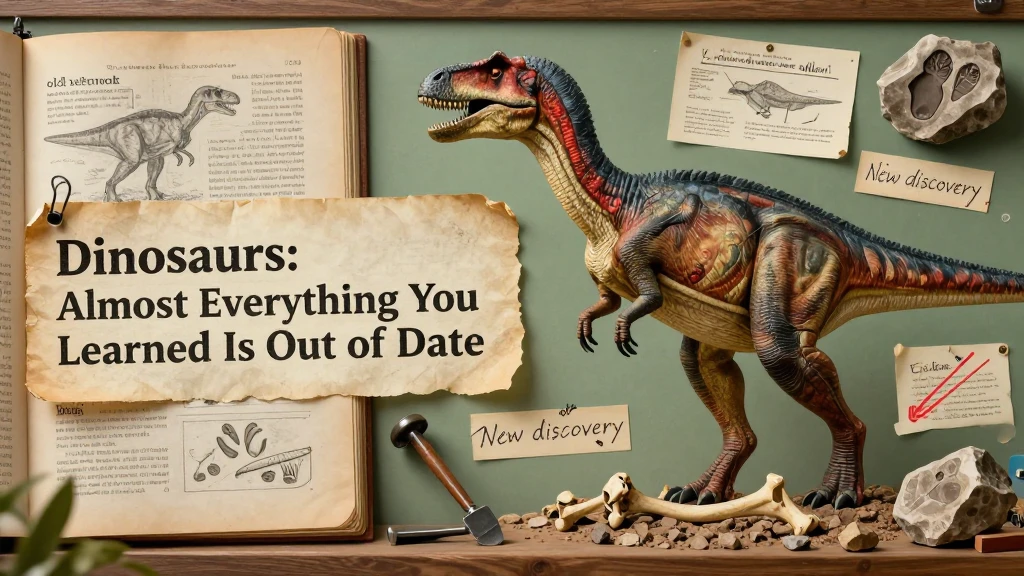
Dinosaurs: Almost Everything You Learned Is Out of Date
Dinosaur knowledge has a strange quality: most adults are working from a picture book they read at seven, updated once by a film in 1993. Both are now badly out of date.
The Age of Dinosaurs
Dinosaurs lived during the Mesozoic Era, which is divided into three periods: the Triassic, when the first dinosaurs appeared, roughly 230 million years ago; the Jurassic, the age of giant long-necked plant-eaters; and the Cretaceous, which ended with the mass extinction 66 million years ago. Despite the film's title, many of the stars of Jurassic Park — including T. rex and Velociraptor — actually lived in the Cretaceous.
The Timeline Nobody Believes
Stegosaurus lived roughly 150 million years ago. Tyrannosaurus rex lived roughly 68 to 66 million years ago. That is a gap of over 80 million years — which means T. rex is closer in time to you, reading this, than it ever was to Stegosaurus.
People routinely picture them fighting. They missed each other by a span longer than the entire age of mammals.
The Feathers
Velociraptor was not the man-sized reptile stalking a kitchen. It was roughly the size of a turkey, and fossil evidence — including quill knobs on its arm bones — indicates it was feathered. The film's "raptors" were closer in size to a relative called Deinonychus. Many other dinosaurs had feathers too. The scaly, lizard-like dinosaur of old illustrations has been steadily replaced by something that looks far more like a bird — because that is what it was closer to.
They Are Not Extinct
This is the part that still catches people. Birds are dinosaurs — specifically, they are the surviving branch of the theropods, the same group that produced T. rex. The link was first suggested in the 1860s, after the discovery of Archaeopteryx, a feathered creature with teeth and a bony tail.
The non-avian dinosaurs died out around 66 million years ago, most likely following an asteroid impact at Chicxulub, off what is now Mexico's Yucatán Peninsula. The crater is about 180 kilometres wide. The avian dinosaurs survived — and they are outside your window.
Records and Giants
- The largest dinosaurs were long-necked sauropods such as Argentinosaurus and Patagotitan from South America, which may have weighed as much as 60 to 70 tonnes.
- T. rex had one of the most powerful bites of any land animal ever. Its arms were short, but they were muscular.
- Spinosaurus was probably longer than T. rex and spent much of its time in water, hunting fish.
- "Sue", one of the largest and most complete T. rex skeletons ever found, is displayed at the Field Museum in Chicago.
Things That Were Not Dinosaurs
Pterosaurs, which flew, were not dinosaurs. Plesiosaurs and ichthyosaurs, which swam, were not dinosaurs. Neither was Dimetrodon, with the sail on its back, which is closer to your ancestors than to T. rex. "Dinosaur" is a specific group, not a synonym for "big extinct reptile" — and quizzes love this distinction.
The People Who Found Them
Mary Anning was pulling ichthyosaur and plesiosaur fossils out of the cliffs at Lyme Regis in the early 1800s, at a time when the Geological Society would not admit her as a member because she was a woman. Much of what she found was published by men who did not credit her. The scientific establishment has since caught up, roughly two centuries late.
The first dinosaur to be scientifically named was Megalosaurus, by William Buckland in 1824. Early scientists made plenty of mistakes: Iguanodon's thumb spike was first placed on its nose like a horn. In the late 1800s, American palaeontologists Edward Drinker Cope and Othniel Charles Marsh competed so fiercely to find new species — bribing, spying and even destroying fossils — that their rivalry became known as the "Bone Wars".
And Brontosaurus? For about a century it was considered a mistaken name for Apatosaurus. In 2015, a detailed study argued it was a separate genus after all, and the name came back.
The word "dinosaur" itself was coined in 1842 by Richard Owen, and means "terrible lizard" — which, given what we now know about the feathers, has aged about as well as everything else on this list. Test yourself in the free Animals & Nature quiz.