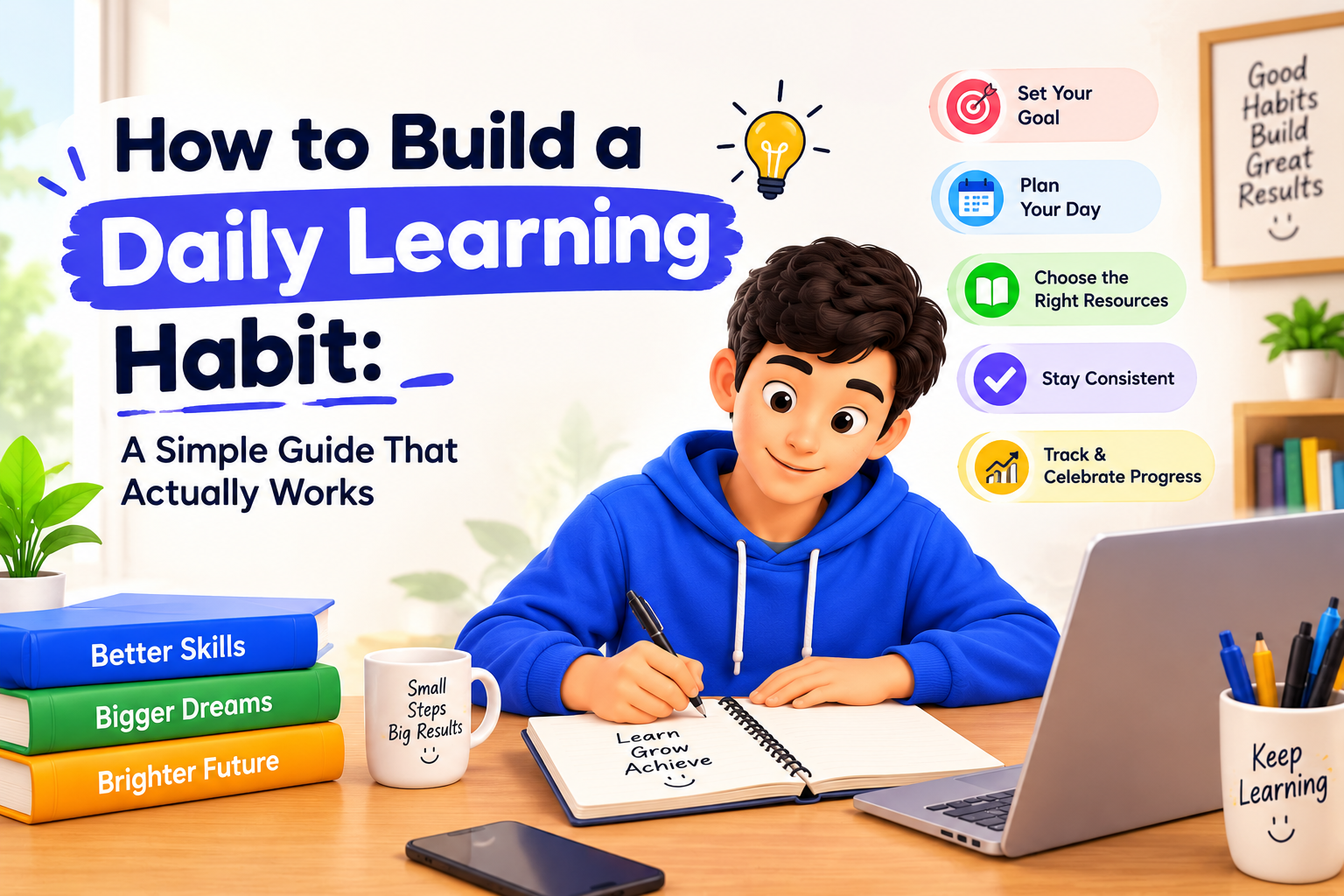
How to Build a Daily Learning Habit: A Simple Guide That Actually Works
How to Build a Daily Learning Habit: A Simple Guide That Actually Works
Learning something new every day sounds like a great goal, but many people struggle to turn that goal into a consistent habit. They may start with enthusiasm, spend hours studying for a few days, and then gradually stop when life becomes busy.
The problem usually isn't a lack of motivation. The bigger problem is trying to make learning too complicated or demanding.
A daily learning habit works better when it is small, predictable, and easy to repeat. You don't need several free hours every day. Even 15 to 20 focused minutes can become valuable when you use that time consistently.
In this guide, you'll learn how to create a realistic learning routine, choose useful topics, remember what you learn, and stay consistent even on busy days.
What Is a Daily Learning Habit?
A daily learning habit is a regular routine in which you spend some time each day gaining, reviewing, or practicing knowledge.
It doesn't necessarily mean sitting down with a textbook. Learning can include reading an article, watching an educational video, exploring a new subject, practicing a skill, answering quiz questions, or reviewing something you learned previously.
The most important part is consistency. The goal is to make learning something you naturally return to rather than something you only do when you feel motivated.
Why Learning a Little Every Day Can Be Powerful
Trying to learn a huge amount of information in one session can feel productive, but it can also be difficult to maintain.
A smaller daily routine is easier to fit around work, school, family, and other responsibilities. It also gives you repeated opportunities to review information instead of learning something once and forgetting about it.
Imagine spending just 20 minutes a day learning. That's more than two hours of focused learning each week and more than 120 hours over a year if you maintain the habit consistently.
The individual sessions may feel small, but the accumulated effort can become significant.
10 Steps to Build a Daily Learning Habit
1. Start With a Small Daily Goal
One of the biggest mistakes beginners make is setting an unrealistic target. Saying "I will study for two hours every day" may sound impressive, but it can be difficult to maintain.
Instead, start with something that feels almost too easy. Ten or fifteen minutes is enough to establish the habit.
Once the routine becomes natural, you can increase the amount of time if you want.
Try this: Commit to just 15 minutes of learning every day for the first two weeks.
2. Choose a Specific Learning Goal
"I want to learn more" is a good intention, but it isn't a very specific goal.
Give your learning a clear direction. You might want to improve your general knowledge, understand world history, learn about technology, improve your vocabulary, or explore science.
A specific goal makes it easier to decide what you should learn each day.
Instead of: "Learn something new."
Try: "Learn five new facts about world geography."
3. Connect Learning to an Existing Routine
A new habit is easier to remember when it is connected to something you already do.
For example, you could learn for 15 minutes after your morning coffee, during your lunch break, after dinner, or before going to bed.
This creates a predictable trigger for the habit. Eventually, the activity can start to feel like a normal part of your day.
Tip: Pick one time of day and try to keep it consistent rather than changing your schedule every day.
4. Remove Unnecessary Friction
Sometimes the hardest part of learning is simply getting started. If you need to search for resources, organize notes, find a topic, and prepare everything before you begin, you may lose motivation.
Make the process as simple as possible. Keep your preferred learning resources easy to access and decide what you'll study ahead of time.
The fewer steps between you and the learning activity, the easier it becomes to begin.
5. Use Active Recall Instead of Only Reading
Reading is useful for introducing new information, but simply rereading something doesn't always tell you how well you can remember it.
Active recall means trying to retrieve information from memory without looking at the answer first.
Quizzes are a simple way to practice active recall. After learning about a topic, test yourself with a few questions and see what you can remember.
Example: After reading about a country, close your notes and try to remember its capital, location, currency, and one interesting fact.
6. Keep Your Daily Sessions Short and Focused
More learning time isn't automatically better. A distracted hour can be less useful than a focused 20 minutes.
During your learning session, remove unnecessary distractions. Put your phone aside if you don't need it, close unrelated tabs, and focus on one topic.
Once the session ends, stop. Leaving yourself wanting to continue can make it easier to return the next day.
7. Learn From Your Mistakes
Mistakes are a natural part of learning. Instead of avoiding questions that you find difficult, use them to identify what you need to work on.
If you get a quiz question wrong, don't just memorize the correct answer. Take a moment to understand why it is correct.
This turns an incorrect answer into a useful learning opportunity.
8. Review What You Learned
Learning something once doesn't guarantee that you'll remember it later. Regular review gives your brain additional opportunities to retrieve the information.
Your review doesn't have to be complicated. At the beginning of a learning session, spend a few minutes recalling what you learned yesterday.
You can also return to older topics at the end of each week.
9. Track Your Progress Without Obsessing Over It
Tracking can make a habit visible. You might keep a simple calendar, note, spreadsheet, or habit tracker showing the days you completed your learning session.
You can also track quiz scores, completed topics, or the number of learning sessions you've finished.
However, don't let tracking become more complicated than learning itself. The tracker is there to support the habit, not become the main activity.
10. Make Learning Enjoyable
A habit is easier to maintain when you actually enjoy doing it. You don't have to learn through the same format every day.
Mix reading, videos, quizzes, discussions, experiments, and exploration. Follow subjects that genuinely make you curious.
If you enjoy history, explore historical events. If you're interested in science, investigate how everyday things work. If you love trivia, turn your learning into a quiz challenge.
A Simple 20-Minute Daily Learning Routine
If you're not sure where to start, try this simple routine.
- 5 minutes: Review something you learned previously.
- 10 minutes: Learn something new about your chosen topic.
- 5 minutes: Test yourself with questions or explain what you learned in your own words.
That's it. You don't need an elaborate study system to get started. Once this routine becomes comfortable, you can adjust the length or structure based on your goals.
Example Weekly Learning Plan
Variety can make your learning routine more interesting. Here's one example of how you could organize a week.
| Day | Topic | Activity |
|---|---|---|
| Monday | History | Learn about one historical event |
| Tuesday | Science | Explore a scientific concept |
| Wednesday | Geography | Learn about a country or region |
| Thursday | Technology | Learn how a technology works |
| Friday | Culture | Explore art, language, music, or traditions |
| Saturday | Trivia | Take a mixed general knowledge quiz |
| Sunday | Review | Review the week's learning |
What to Do on Days When You're Too Busy to Learn
Life won't always go according to plan. There will be days when work, travel, family responsibilities, or unexpected events take priority.
Don't assume that missing one session means your habit has failed. Instead, create a smaller version of the habit for busy days.
For example, if your normal routine is 20 minutes, your minimum version could be just five minutes. Read one short article, answer five quiz questions, or review three facts.
The goal is not to maintain a perfect streak. The goal is to make it easy to return to learning after a busy day.
Common Mistakes That Make Learning Habits Harder
- Setting goals that are too ambitious: Starting with a manageable routine is usually easier to maintain.
- Trying to learn everything: Choose a few topics instead of constantly jumping between unrelated subjects.
- Only consuming information: Include quizzes, recall, practice, and explanations in your routine.
- Expecting immediate results: Knowledge builds gradually. Give the habit time to develop.
- Giving up after missing a day: One missed session doesn't erase your progress. Simply continue.
- Making the system too complicated: Your learning system should save time, not create more work.
Make Daily Learning More Fun With Game Gems
Learning doesn't have to feel like homework. A few minutes of trivia can turn a short break into an opportunity to learn something new.
Game Gems lets you explore quizzes across different topics, including general knowledge, history, science, geography, technology, sports, animals, and more.
You can use short quizzes as part of your daily routine: learn something new, test yourself, review the answers, and come back tomorrow for another challenge.
Frequently Asked Questions
How long should I spend learning each day?
There is no universal amount of time that works for everyone. Starting with 10 to 20 focused minutes can be a practical way to establish the habit. You can increase the time later if your schedule allows.
What should I learn every day?
Choose topics that match your goals and interests. You could study history, science, geography, technology, languages, general knowledge, or a specific skill. Mixing subjects throughout the week can also keep your routine interesting.
Is 15 minutes of learning a day enough?
Fifteen minutes can be a useful starting point. The value comes from using that time consistently and actively engaging with the material. Over weeks and months, small sessions can add up to a substantial amount of learning time.
How can I stay motivated to learn every day?
Make the routine small, connect it to an existing daily activity, choose topics you're genuinely interested in, and track your progress. Quizzes and other interactive activities can also make practice more enjoyable.
What should I do if I miss a day?
Simply continue the next day. Missing one session doesn't mean the habit has failed. Avoid trying to compensate with an unnecessarily long study session; focus on returning to your normal routine.
Are quizzes good for a daily learning routine?
Yes. Quizzes provide a simple way to practice recalling information and identify topics that need more review. They can work particularly well as a short activity at the end of a learning session.
Make Learning a Part of Your Everyday Life
Building a daily learning habit doesn't require extraordinary discipline or a complicated schedule. Start small, choose a realistic time, and make the activity easy to repeat.
Learn something new, test what you remember, review your mistakes, and return to the habit tomorrow.
Some days you'll learn a lot. Other days you may only have five minutes. Both are valuable if they help you maintain the habit.
Don't focus on learning everything. Focus on learning something consistently.
Over time, those small daily sessions can become one of the most useful habits you build.