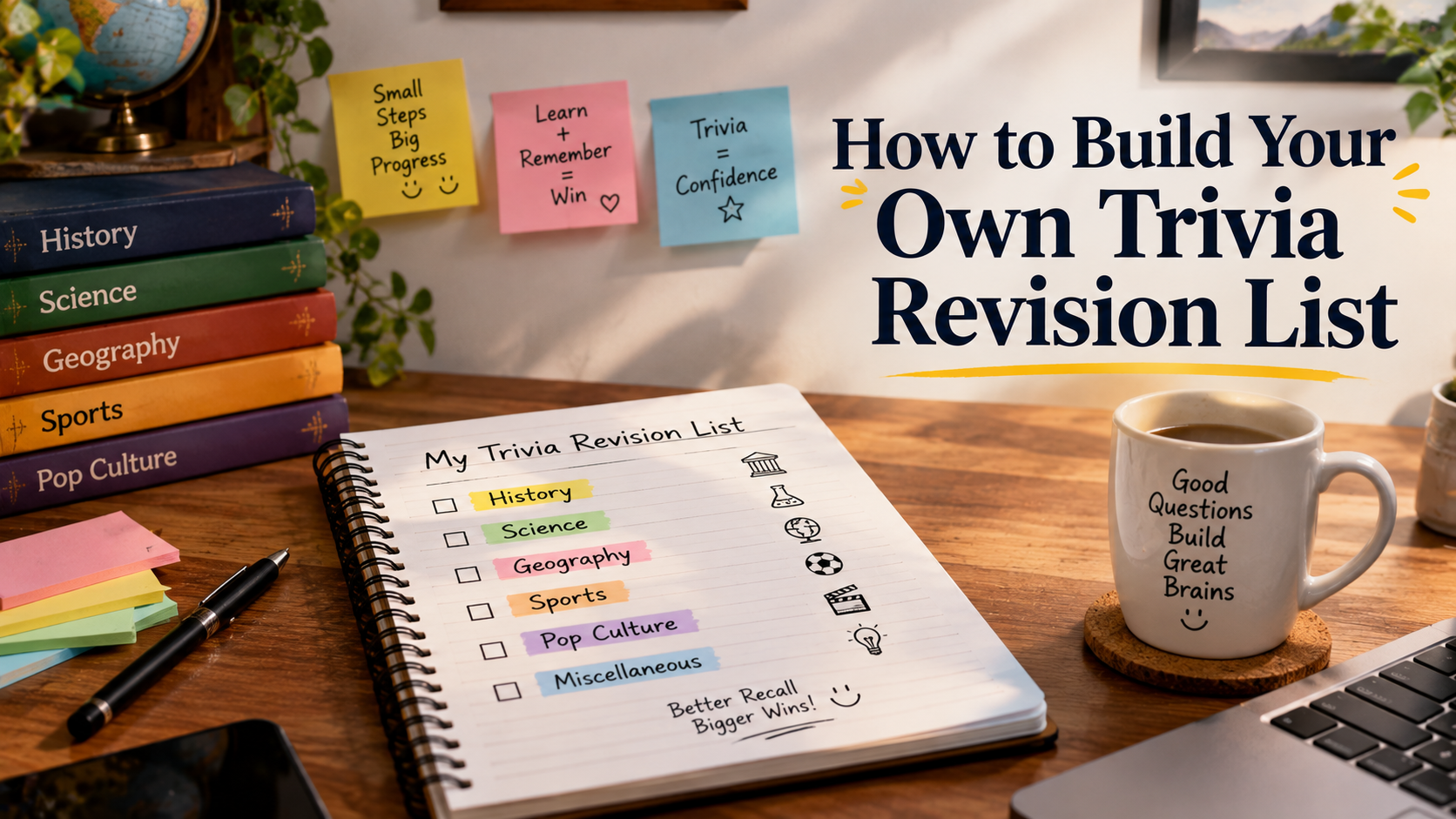
How to Build Your Own Trivia Revision List
Trying to remember hundreds of random facts before a quiz can get messy very quickly. You read something interesting, save it somewhere, forget where you saved it, and then start looking for it again a few days later.
A simple trivia revision list can make this much easier.
The idea is not to create a giant document containing every fact you have ever learned. A useful revision list should help you quickly revisit the information you are most likely to forget, the questions you got wrong, and the topics where you need more practice.
Start With the Facts You Keep Forgetting
The best place to begin is not a random list of trivia from the internet. Start with your own quiz experience.
Think about questions you recently answered incorrectly or questions where you knew the answer only after seeing it. Write those facts down first.
For example, if you repeatedly confuse two countries and their capitals, add both to your list. If you keep mixing up two historical events, record the difference between them.
These are the facts that deserve your attention because you already know they cause problems for you.
Divide Your List Into Topics
Putting everything into one enormous list makes revision harder. Instead, divide your notes into familiar trivia categories.
- History
- Geography
- Science
- Sports
- Movies and TV
- Music
- Literature
- Technology
- Food
- Animals
- General Knowledge
You do not need to use every category. Choose the ones that actually appear in the quizzes you play.
Keeping topics separate also makes focused revision possible. If you have a geography quiz coming up, you can review geography without scrolling through hundreds of unrelated facts.
Keep Each Entry Short
A revision list is meant for quick review, not for writing an entire encyclopedia.
Instead of copying a long explanation, reduce each fact to the information you need to remember.
For example:
Question: What is the capital of Australia?
Answer: Canberra
Or:
Fact: The Great Wall is located in China.
If a fact is confusing, add one short note explaining what makes it easy to mix up. That is usually more useful than copying a paragraph from another website.
Make a Separate Section for Wrong Answers
This can become one of the most valuable parts of your revision list.
Whenever you get a quiz question wrong, add it to a Wrong Answers section.
Do not just write the correct answer. Record what you chose as well if the mistake was caused by confusion between two similar options.
For example:
Question: Which planet has the shortest year?
My answer: Mars
Correct answer: Mercury
Seeing the mistake again gives your brain a reason to pay attention to that fact. Over time, your wrong-answer list can become more useful than a general collection of trivia facts.
Mark Facts That Are Easy to Confuse
Some facts are difficult because they are completely unfamiliar. Others are difficult because they look almost identical to another fact you already know.
Give these facts special attention.
Countries and capitals, historical dates, scientific terms, authors and books, athletes and records, and similar-sounding names are common examples.
You can put them into a separate Easy to Confuse section or add a small note beside them.
The goal is to remind yourself exactly what caused the confusion.
Turn Facts Into Questions
Instead of always writing statements, turn important facts into mini quiz questions.
For example:
Statement: Canberra is the capital of Australia.
can become:
Question: What is the capital of Australia?
Answer: Canberra
This makes revision more active. You are trying to recall the answer instead of simply looking at it.
That small change can make a big difference when you are preparing for an actual quiz.
Do Not Add Every Interesting Fact You Find
This is where many revision lists go wrong.
You find an interesting trivia article and start copying fact after fact. A week later, your list has hundreds of entries, and revising it feels like another full-time job.
Before adding a fact, ask yourself:
- Is this useful for the type of quizzes I play?
- Did I get this wrong or struggle to remember it?
- Is it connected to a topic I am currently studying?
- Would I recognize this information if it appeared as a quiz question?
If the answer to all of these is no, you probably do not need it in your revision list.
Use a Simple Priority System
Not every fact needs the same amount of revision.
You can mark entries with three simple levels:
- High: I regularly forget this.
- Medium: I sometimes remember it incorrectly.
- Low: I usually remember it without trouble.
Spend most of your revision time on the high-priority facts. There is little benefit in repeatedly reviewing something you already know perfectly.
Review Your List in Short Sessions
You do not need to spend an hour reading your entire trivia list every day.
A short session can be enough. Pick one category, cover the answers, and test yourself on a small group of questions.
For example, you might review 15 geography questions today and 15 history questions tomorrow.
Short sessions also make it easier to keep the habit going. A revision system that takes ten minutes and actually gets used is more useful than a complicated system that you abandon after three days.
Remove Facts You Have Mastered
Your revision list should change over time.
If you have answered the same question correctly several times across different quizzes, move it out of your main revision list.
You can keep an archive of mastered facts if you want, but your active list should stay focused on information that still needs attention.
This prevents the list from becoming unnecessarily large.
Update It After Every Quiz
One of the easiest ways to keep your list useful is to update it immediately after playing a quiz.
Write down:
- Questions you got completely wrong.
- Questions you guessed correctly.
- Questions where you knew the topic but forgot the exact answer.
- Facts that surprised you.
- Facts you confused with something similar.
You do not have to record every question. Just capture the ones that teach you something about what you need to improve.
Keep the Format Consistent
Your list can be in a notebook, spreadsheet, notes app, or document. The tool matters less than the structure.
Try to keep each entry in roughly the same format. For example:
Category: Geography
Question: What is the capital of Kazakhstan?
Answer: Astana
Note: I previously confused it with Almaty.
When every entry follows a familiar structure, you can scan the list much faster.
Build the List Around Your Own Weak Spots
There is no single perfect trivia revision list.
Someone who loves history may have pages of historical dates but struggle with sports. Another player may know geography extremely well but regularly forget science terminology.
Your list should reflect those differences.
After a few weeks, you will start noticing patterns in your mistakes. Those patterns tell you where your revision time is actually worth spending.
A Simple Trivia Revision List Template
If you are starting from scratch, you can use this basic structure:
- Wrong Answers – Questions you answered incorrectly.
- Easy to Confuse – Similar facts that you often mix up.
- Need to Remember – Important facts you still struggle to recall.
- By Topic – History, Geography, Science, Sports, and other categories.
- Mastered – Facts you can now answer confidently.
Keep adding to it as you play more quizzes, but keep removing information that no longer needs regular revision.
Final Thoughts
A good trivia revision list is not the longest one. It is the one that helps you remember the things you actually struggle with.
Start with your wrong answers, organize them by topic, turn important facts into questions, and review them in short sessions. As your knowledge improves, remove the facts you have mastered and give more attention to the ones that continue to cause mistakes.
After a while, your revision list becomes more than a collection of facts. It becomes a record of your own quiz mistakes—and a practical way to turn those mistakes into better performance.