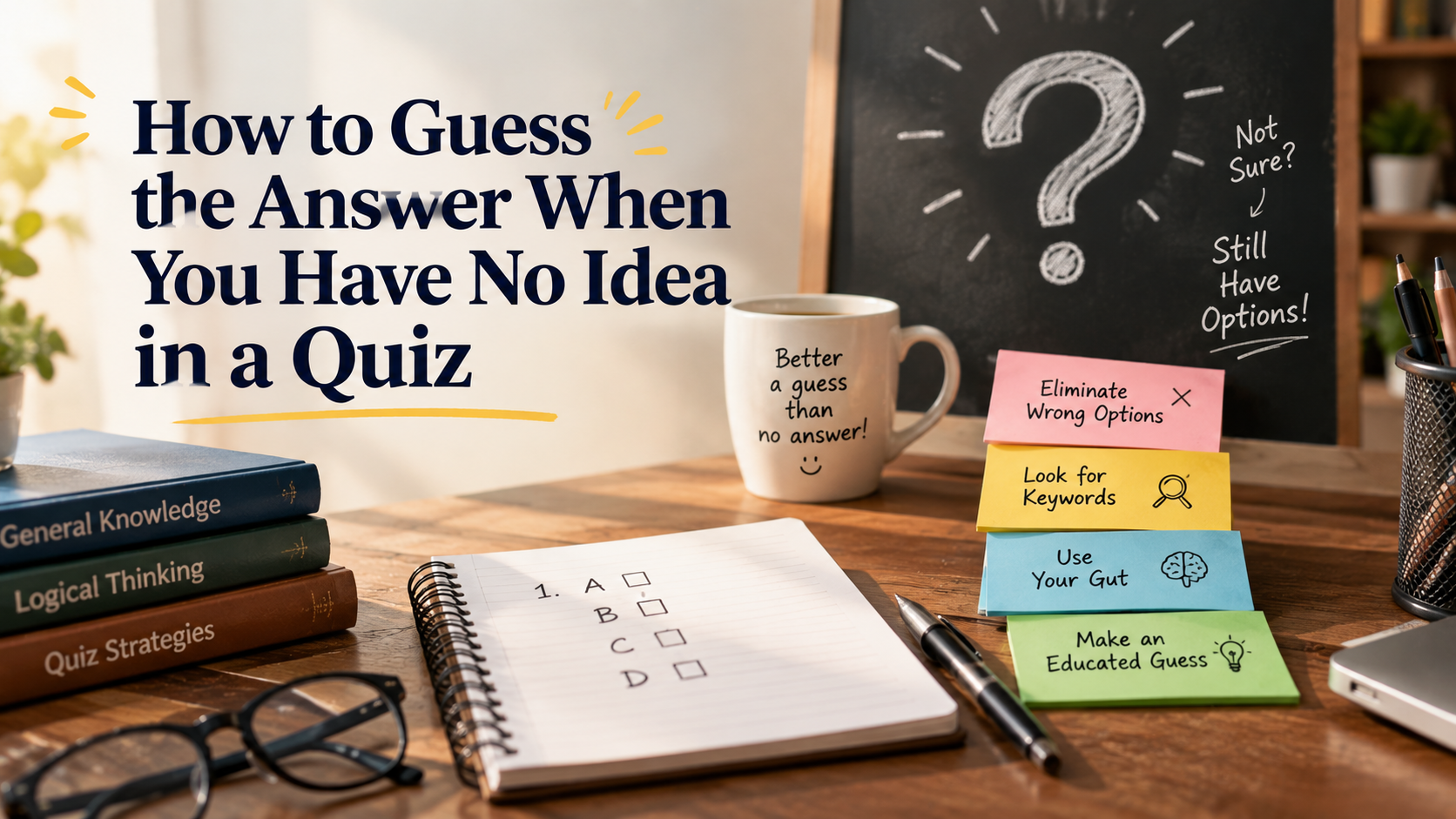
How to Guess the Answer When You Have No Idea in a Quiz
Every quiz has that one question where you look at the options and think, “I honestly have no idea.” It happens to everyone, even people who know a lot of trivia.
The good news is that guessing does not always have to mean picking an answer at random. Sometimes the question itself gives you small clues. The wording, the type of answers, and even the options you can eliminate can help you make a more sensible choice.
Of course, there is no trick that can turn an unknown answer into a guaranteed correct one. But when you genuinely do not know, a few simple habits can improve the way you make your guess.
Read the Question One More Time
Before looking too closely at the answers, read the question again.
It is surprisingly easy to miss a small word such as “first,” “largest,” “not,” “before,” or “only.” One word can completely change what the question is asking.
If you rushed through the question the first time, slowing down for a few seconds may reveal something you missed. Sometimes you do not actually need to know the answer immediately—you just need to understand the question correctly.
Eliminate the Answers You Know Are Wrong
This is probably the most useful technique when you are unsure.
Suppose a multiple-choice question gives you four options. You may not know the correct answer, but you might recognize that one or two options cannot be right.
Once those choices are removed, you are no longer guessing between four possibilities. You may only have two realistic options left.
For example, imagine a question asks which person was associated with a particular historical event. If you recognize that two names belong to completely different periods, you can remove them even if you cannot remember the exact answer.
Knowing what is wrong can sometimes be just as useful as knowing what is right.
Look at the Category of the Answers
Pay attention to what kind of answers are being offered.
Are they all years? Countries? Scientists? Cities? Movies? Inventions?
Once you identify the category, think about what the question is actually asking and whether each option fits that context.
For example, if a question asks about an ancient civilization and one option is a person from a much later historical period, that option deserves closer scrutiny. You do not need to know the answer perfectly to notice that something does not fit.
Use What You Already Know
Even when you do not remember the exact fact, you may remember something connected to it.
Maybe you remember the country but not its capital. You remember the scientist but not the year. You remember that a movie won an award but cannot recall which year.
Use that partial knowledge.
Trivia is full of connected facts. A small piece of information can sometimes narrow down the possibilities enough to make a better guess.
Be Careful With Very Extreme Answers
Sometimes an answer looks suspicious because it is extremely large, extremely small, or unusually specific. That does not automatically make it wrong, though.
Do not use a rule like “the biggest number must be false” or “the most unusual option is never correct.” Real quiz questions can have surprising answers.
Instead, treat unusual options as a reason to think for another moment. Ask yourself whether you have seen something related to that answer before.
Watch the Wording of the Question
Question wording can give you useful information.
A question asking “Which of these was the first…” is testing something different from one asking “Which of these is the largest…”. Likewise, “according to,” “originally,” “currently,” and “traditionally” can change the expected answer.
Do not search for hidden tricks in every question. Most quiz questions are simply asking what they say. But reading the exact wording can prevent you from answering a slightly different question in your head.
Think About Associations
When you see an unfamiliar question, look for associations between the question and the options.
A name might remind you of a particular country. A city might remind you of a famous landmark. A historical figure might remind you of an invention or event.
That association may not be enough to prove the answer, but it can help you connect information you already know.
This is especially useful in general knowledge quizzes, where questions often connect history, geography, science, entertainment, and culture.
Do Not Change Your Answer Without a Reason
One of the most common quiz mistakes is changing an answer simply because it suddenly feels wrong.
If your first choice came from a genuine memory or a reasonable process of elimination, do not change it just because you became nervous.
Change your answer when you remember something new, notice a mistake in your reasoning, or find a clear reason that another option fits better.
A feeling of doubt by itself is not new evidence.
Use the Question to Trigger Your Memory
Sometimes you know the information but cannot access it immediately.
Instead of staring at the options, try asking yourself a related question.
If you see a question about a historical date, think about the event around that date. If it asks for a capital, picture the country's map. If it asks about a film, think about its actors, director, or release period.
You may not remember the answer directly, but the related information can bring it back.
Do Not Overthink a Completely Unknown Question
There is a point where thinking longer does not help.
If you have eliminated what you can, checked the wording, considered your related knowledge, and still have no idea, make your best guess and move on.
Spending several minutes on one question can hurt your performance if the quiz has a time limit. A difficult question should not prevent you from answering questions you actually know.
What If There Is No Negative Marking?
If a quiz does not deduct points for wrong answers, leaving a question unanswered usually gives up the opportunity to score from a guess.
In that situation, once you have done whatever reasoning you can, making an educated guess can be worthwhile.
If the quiz does use negative marking, the decision is different. Check the quiz rules first and understand how much a wrong answer costs before guessing.
A Simple Guessing Routine
When you completely blank on a question, try this quick routine:
- Read it again: Make sure you did not miss an important word.
- Remove obvious wrong answers: Use facts you already know.
- Check the category: See what type of answer the question requires.
- Use related knowledge: Think about facts connected to the topic.
- Compare the remaining options: Look for the one that fits the question best.
- Check the scoring rules: Know whether wrong answers carry a penalty.
- Move on: Do not let one unknown question take over the quiz.
Guessing Is Not the Same as Randomly Picking
There is an important difference between a random guess and an educated guess.
A random guess means choosing an option without using any information. An educated guess uses whatever information is available—even if that information is incomplete.
You may know that an option does not fit the time period. You may recognize two names but not the other two. You may remember a related fact. You may notice that you misunderstood the wording at first.
None of these guarantees the answer, but together they can give you a better basis for choosing.
Final Tip: Stay Calm
A question you cannot answer immediately does not mean you are doing badly. Every quiz contains questions that fall outside your knowledge.
The goal is not to know everything. It is to make the best decision with the information you have.
So when you see a question and your mind goes completely blank, do not panic. Read it carefully, eliminate what you can, connect it to what you already know, and make a reasoned choice if the quiz rules allow it.
Sometimes the answer you are looking for is not hiding in your memory as a complete fact. A small clue is enough to help you find your way there.