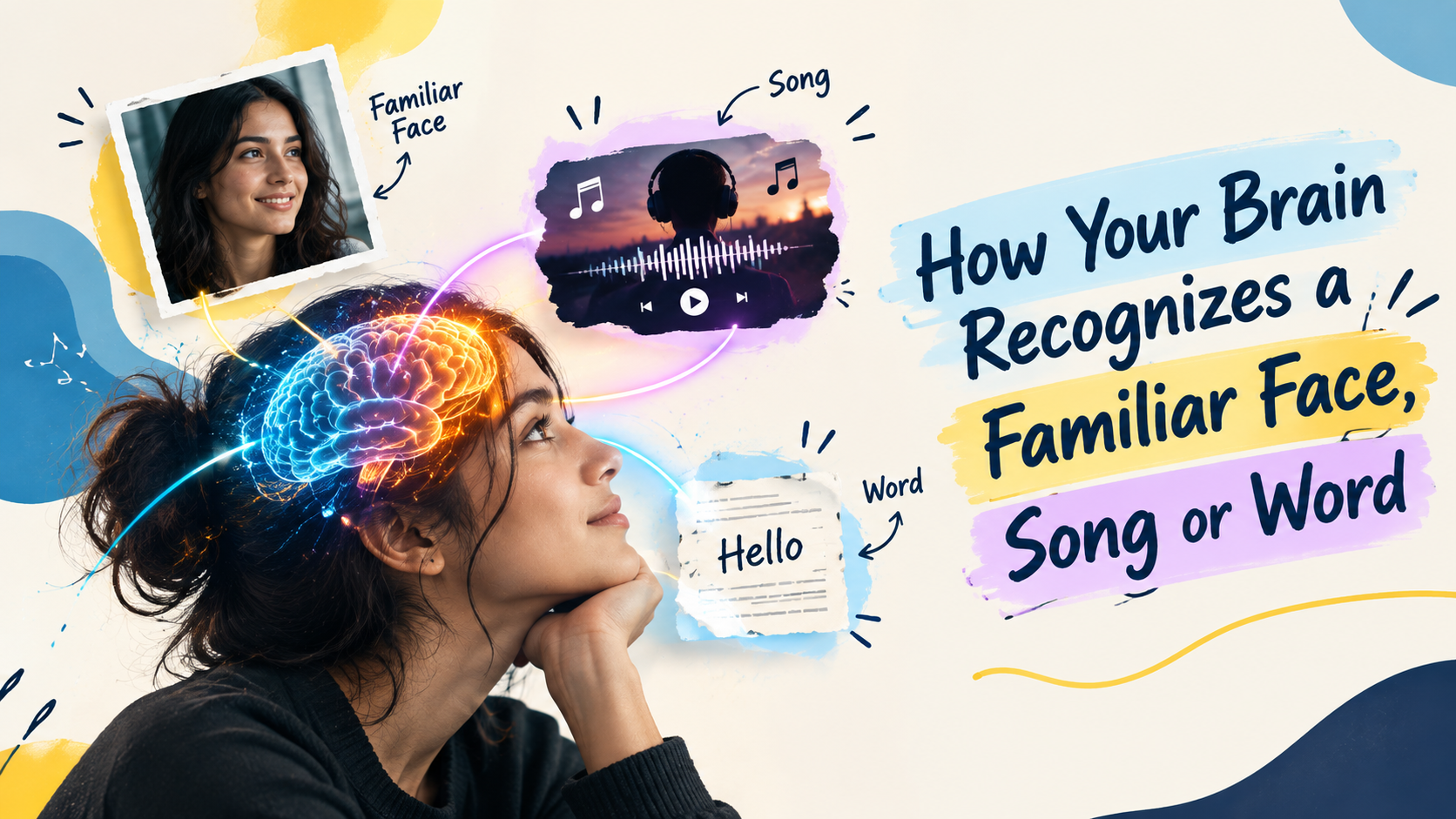
How Your Brain Recognizes a Familiar Face, Song or Word
You can walk into a crowded room and recognize a friend before they even say hello. You can hear just a few seconds of a song and know exactly what it is. Sometimes, you can see a word for only a moment and instantly understand what it says.
These things feel effortless. Your brain seems to simply know.
But recognition is actually a complicated process happening incredibly quickly. Your brain takes information from your eyes or ears, compares it with patterns stored in memory, and decides whether something feels familiar.
Your Brain Is Always Comparing Patterns
One useful way to think about recognition is as a comparison between what you are experiencing right now and information your brain has encountered before.
When you see a face, for example, your brain does not need to consciously measure every feature one by one. It picks up patterns such as the shape of the face, the position of the eyes, the nose, the mouth, and other visual details.
Those details are processed together and compared with information already stored in your memory.
If enough of the pattern matches, you may recognize the person almost instantly.
How Do You Recognize a Familiar Face?
Faces are especially important to humans, so our brains are very good at detecting and recognizing them.
When you look at someone you know, visual information from your eyes travels through areas involved in processing what you see. A region of the brain called the fusiform face area is strongly associated with face perception and recognition.
Your brain looks at the overall arrangement of facial features rather than treating each feature as a completely separate object.
That is why you can often recognize a friend from far away, even when you cannot clearly see every detail of their face.
Interestingly, recognition does not always require a perfect view. A familiar hairstyle, walking style, voice, or even the way someone stands can sometimes help your brain identify them.
Why Can You Recognize a Song in Just a Few Seconds?
Music uses a different kind of recognition, but the basic idea is similar.
When you hear a familiar song, your brain processes features such as pitch, rhythm, melody, tempo, and the pattern of sounds. These details can trigger memories of songs you have heard before.
Sometimes, just the opening notes are enough.
You might hear a song playing in a shop and immediately think, “I know this song,” before you can remember its title or the artist.
That happens because recognition can happen before you can consciously recall all the information connected to it.
Why Do Songs Get Stuck in Your Head?
The same connection between music and memory can sometimes work a little too well.
A short melody can repeat in your mind even when the music has stopped playing. This is commonly called an earworm.
Catchy melodies, repeated phrases, and songs you have heard many times can create strong memory associations. Your brain may continue replaying part of the pattern even though there is no actual sound playing around you.
How Does Your Brain Recognize a Word?
Reading also depends heavily on pattern recognition.
When you read a familiar word, your brain does not simply look at each letter in isolation. It processes visual information about the letters and their arrangement, then connects that pattern with information stored in memory.
For common words, this can happen so quickly that you barely notice the process.
Try looking at a familiar sentence. You probably do not stop and consciously think about every individual letter. Your brain recognizes many of the words almost automatically.
Why Can You Read Messy Handwriting?
Sometimes you can understand handwriting even when some letters are difficult to read.
That is partly because your brain uses context. If one letter is unclear, the surrounding letters and the meaning of the sentence can help your brain make sense of it.
For example, if you see a familiar word with one poorly written letter, you may still recognize the word without consciously figuring out exactly what that letter looks like.
Your brain is constantly using clues to fill in missing information.
Recognition Is Not the Same as Remembering
There is an important difference between recognizing something and remembering it without help.
Imagine seeing an actor in a movie. You immediately think, “I have seen this person before.” You recognize the face, but you cannot remember the actor's name.
The same thing happens with songs and words. You may know a song when you hear it but struggle to name it. You may recognize someone's face but forget where you met them.
This is one reason multiple-choice questions can sometimes feel easier than questions where you have to produce the answer yourself. Seeing the possible answers gives your brain additional information to work with.
Why Familiar Things Feel Easier
The more often you encounter something, the stronger the associations around it can become.
Think about your own name. You have probably seen and heard it thousands of times. You do not need to concentrate to recognize it.
The same principle applies to familiar places, voices, logos, songs, words, and faces. Repeated exposure gives your brain more opportunities to build and strengthen associations.
Can Your Brain Recognize Something Without You Realizing It?
Yes, recognition does not always reach conscious awareness immediately.
You may enter a room and feel that something seems familiar without knowing why. A smell might remind you of a place before you can identify the memory. A piece of music might create a feeling of familiarity before you remember when you first heard it.
These experiences show that memory and recognition are not always conscious, step-by-step processes.
What Happens When Recognition Goes Wrong?
Recognition is usually reliable, but it is not perfect.
You might mistake a stranger for someone you know because they have a similar face. You might hear a few notes and confidently guess the wrong song. You might read a word incorrectly because the surrounding sentence led your brain toward the wrong interpretation.
In each case, your brain is trying to make the fastest useful match from the information available.
Your Brain Is Built to Find Familiarity
Recognizing a face, song, or word may feel like a simple mental shortcut, but it depends on several systems working together.
Your senses collect information, your brain identifies patterns, and memory provides previous experiences for comparison. When the pieces match closely enough, familiarity can appear almost instantly.
That is why a face in a crowd can suddenly stand out, a song can bring back an old memory within seconds, or a single word can feel instantly familiar.
Most of the time, you do not notice any of this happening. Your brain has become very good at recognizing the world around you without making you stop and think about how it does it.