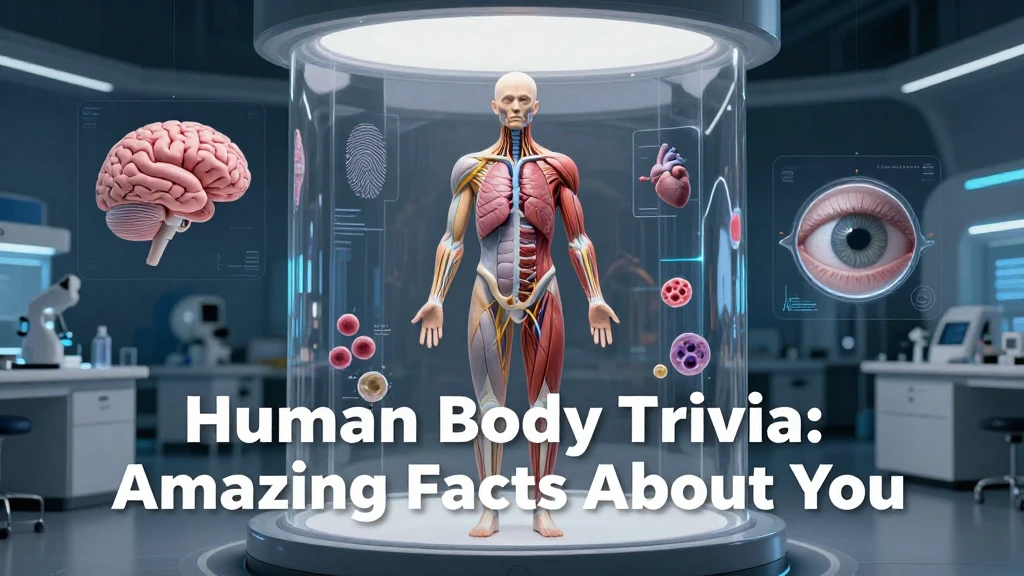
Human Body Trivia: Amazing Facts About You
Game Gems Team · 2026-04-08
The human body is a walking quiz category — full of numbers and oddities that sound impossible until you learn the reason. Here is a collection of facts to sharpen your biology round, grouped by body system and explained so they stay with you.
Bones and Muscles
- Adults have 206 bones, but babies are born with around 300. Many of them, especially in the skull and spine, fuse together as we grow.
- The smallest bone is in your ear. The stapes, or stirrup, is about 3 millimetres long. It is one of three tiny bones that pass sound vibrations to the inner ear.
- The femur, or thigh bone, is the longest and one of the strongest bones in the body.
- More than half of your bones are in your hands and feet — 106 of the 206.
- Babies do not have bony kneecaps. Their kneecaps are made of cartilage and slowly harden into bone during early childhood.
- The body has around 600 muscles. The largest is the gluteus maximus in your buttocks; one of the hardest-working is the heart.
The Brain and Senses
- Your brain uses about a fifth of your body's energy, even though it makes up only around 2% of your body weight.
- Smell is closely linked to memory. Signals from the nose travel to brain areas involved in emotion and memory, which is why a scent can suddenly bring back a childhood moment.
- The human eye can distinguish around a million different colours. Most of us have three types of colour-sensing cone cells.
- The cornea has no blood vessels. It gets oxygen directly from the air, which helps keep it perfectly clear.
- You blink around 15 to 20 times a minute — thousands of times a day — keeping your eyes moist and clean.
Heart and Blood
- Your heart beats around 100,000 times a day — billions of times in a lifetime.
- Blood vessels form an enormous network. If all the arteries, veins and capillaries in an adult were laid end to end, estimates suggest they would stretch tens of thousands of kilometres. The exact figure is debated, but it is a very long way.
- Red blood cells live for about 120 days. Your bone marrow makes millions of new ones every second to replace them.
- Blood is always red. Veins look blue through the skin because of how light passes through tissue, not because the blood inside is blue.
Inside and Out
- Skin is the body's largest organ. In an adult it covers around two square metres.
- You shed tens of thousands of skin cells every minute. Much household dust contains them.
- Tooth enamel is the hardest substance in the body — harder than bone. Unlike bone, it cannot repair itself.
- The liver can regrow. It is the only internal organ that can regenerate significant lost tissue, which is why a living person can donate part of their liver.
- You can live with one kidney. A single healthy kidney can do the work of two.
- Hair grows around a centimetre a month, and fingernails grow faster than toenails.
- Your stomach lining renews itself every few days, protecting it from the strong acid it produces to digest food.
Common Myths to Avoid
- "We only use 10% of our brains." False — brain scans show activity throughout the brain, though not all areas are active at once.
- "Hair and nails keep growing after death." False — the skin dries and shrinks back, making them look longer.
- "Cracking your knuckles causes arthritis." Studies have found no clear link. The sound comes from gas bubbles in the joint fluid.
Why These Facts Stick
Body facts are easiest to remember when you connect them to yourself. Feel your pulse and count it for a minute. Wiggle the small bones in your hand. Notice how often you blink. Each fact turns from a number into something you have experienced, and that is the kind of memory that lasts.
Feeling sharp? Take a free Human Body quiz and see how many of these you can turn into points.