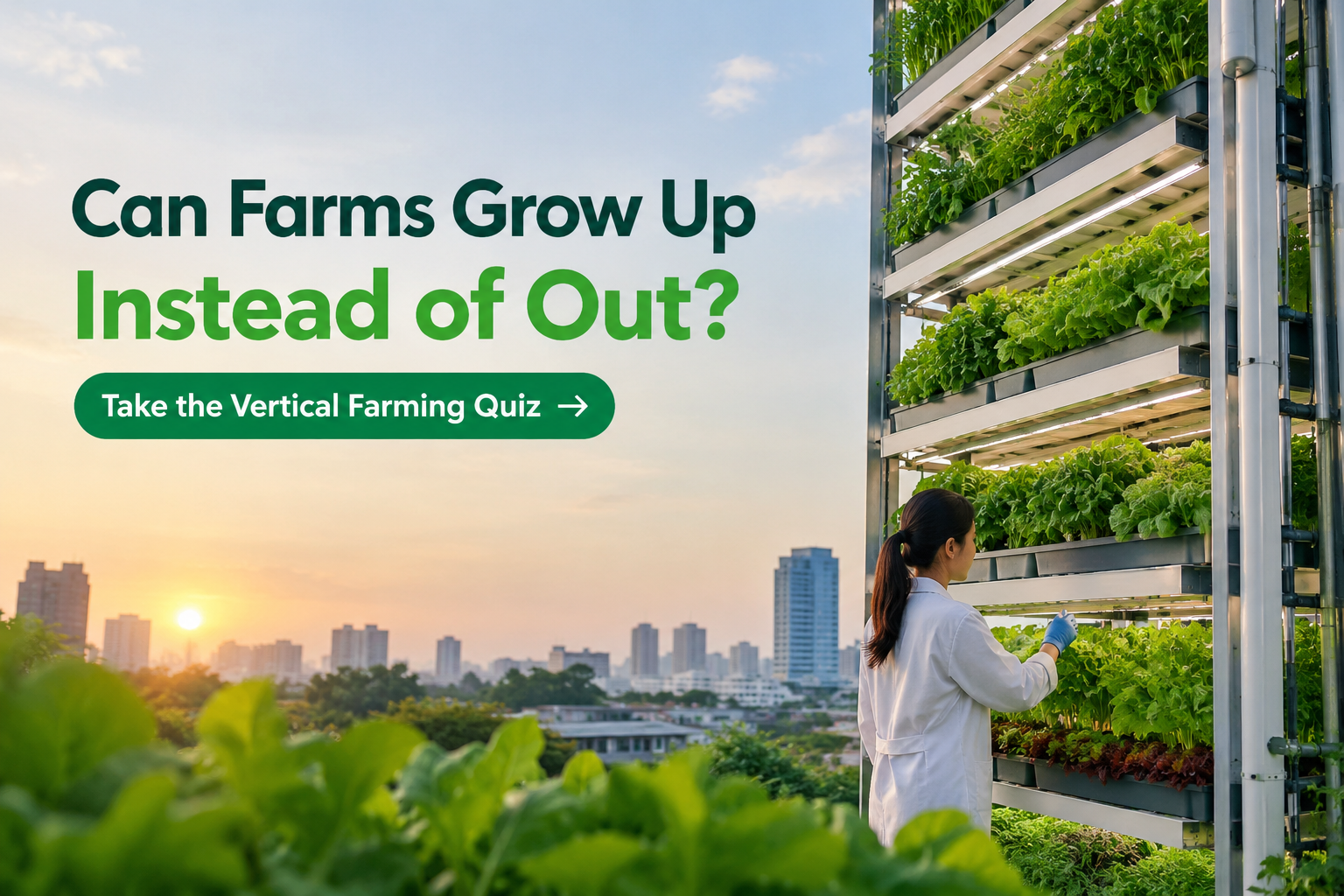
Can Farms Grow Up Instead of Out? Take the Vertical Farming Quiz
Can Farms Grow Up Instead of Out? Take the Vertical Farming Quiz
When you picture a farm, you probably imagine fields stretching towards the horizon. But some farmers are trying a very different approach: growing crops in stacked layers inside buildings, warehouses and specially designed indoor spaces.
This method is known as vertical farming. It can use artificial lighting, carefully controlled temperatures and systems that deliver water and nutrients directly to plants. Some farms do not use traditional soil at all.
The idea sounds promising, especially in places where land is expensive or fresh produce must travel long distances. But vertical farming is not a magic solution. Electricity, equipment, labour and operating costs can make a big difference to whether a farm succeeds.
So, how much do you really know about this unusual way of growing food? Take the quiz below and discover what happens when farming moves indoors.
Watch: What Is Vertical Farming?
This video from the World Economic Forum introduces vertical farming and explains some of its potential benefits.
Vertical Farming Quiz: 50 Questions
Choose your answer before checking the explanation. Each correct answer earns one point.
1. What is vertical farming?
A. Growing crops in stacked layers
B. Growing crops only on mountain peaks
C. Planting trees in straight lines
D. Farming exclusively beneath the ocean
Answer: A. Growing crops in stacked layers.
Explanation: Vertical farming uses multiple growing levels to produce crops within a smaller ground footprint.
2. Where are indoor vertical farms commonly established?
A. Warehouses and purpose-built buildings
B. Only in open deserts
C. Only on the ocean floor
D. Inside moving vehicles
Answer: A. Warehouses and purpose-built buildings.
Explanation: Indoor farms can operate in warehouses, converted buildings and specially designed growing facilities.
3. What does hydroponics use to grow plants?
A. Nutrient-rich water
B. Dry sand without nutrients
C. Pure air alone
D. Solid rock without water
Answer: A. Nutrient-rich water.
Explanation: Hydroponic systems deliver dissolved nutrients to plant roots through water rather than relying on ordinary soil.
4. What is aeroponics?
A. Growing plants with roots exposed to a nutrient mist
B. Growing crops entirely underwater
C. Drying seeds with hot air
D. Growing plants without any nutrients
Answer: A. Growing plants with roots exposed to a nutrient mist.
Explanation: Aeroponic systems deliver water and nutrients to roots through a mist or spray.
5. What is aquaponics?
A. Combining aquaculture with plant cultivation
B. Growing plants using only rainwater
C. Raising fish without water
D. Growing crops in dry storage rooms
Answer: A. Combining aquaculture with plant cultivation.
Explanation: Aquaponics combines fish or other aquatic animal production with plant growing in a connected system.
6. Why do many vertical farms use LED grow lights?
A. To provide light plants can use for photosynthesis
B. To replace every plant nutrient
C. To remove the need for water
D. To make roots grow without oxygen
Answer: A. To provide light plants can use for photosynthesis.
Explanation: LEDs can provide useful wavelengths of light while allowing growers to control lighting schedules and intensity.
7. What is photosynthesis?
A. The process plants use to convert light energy into chemical energy
B. The process plants use to absorb soil particles only
C. The freezing of water inside roots
D. The conversion of leaves into plastic
Answer: A. The process plants use to convert light energy into chemical energy.
Explanation: Plants use light, water and carbon dioxide to produce sugars, releasing oxygen as part of the process.
8. Which gas do plants take in for photosynthesis?
A. Carbon dioxide
B. Helium
C. Neon
D. Pure hydrogen
Answer: A. Carbon dioxide.
Explanation: Plants use carbon dioxide as a carbon source when producing sugars through photosynthesis.
9. Why is temperature control important in an indoor farm?
A. Plant growth depends partly on suitable temperatures
B. Every crop grows best at freezing temperatures
C. Temperature determines the colour of every seed
D. Plants never respond to temperature
Answer: A. Plant growth depends partly on suitable temperatures.
Explanation: Temperature affects processes such as germination, photosynthesis and development. Different crops have different requirements.
10. What is a major reason for stacking plants vertically?
A. To grow more crops per unit of floor area
B. To eliminate the need for light
C. To make all plants grow taller than trees
D. To avoid controlling humidity
Answer: A. To grow more crops per unit of floor area.
Explanation: Multiple growing layers make use of vertical space instead of spreading every crop across a single ground-level area.
11. Which crop is commonly suitable for indoor vertical farming?
A. Lettuce
B. Mature oak trees
C. Large timber trees
D. Field-grown sugarcane on a commercial scale in every setup
Answer: A. Lettuce.
Explanation: Leafy greens such as lettuce are common vertical-farm crops because they grow relatively quickly and can be grown in compact spaces.
12. Why can leafy greens be attractive crops for vertical farms?
A. Many grow relatively quickly and do not need deep root space
B. They require no water at any stage
C. They grow without light
D. They never need nutrients
Answer: A. Many grow relatively quickly and do not need deep root space.
Explanation: Their growth habits and compact structure can suit indoor racks and controlled growing systems.
13. Why can growing wheat indoors be more challenging than growing lettuce?
A. Wheat produces a different crop structure and may have less favourable economics under indoor lighting
B. Wheat cannot grow in soil
C. Wheat never needs sunlight outdoors
D. Wheat has no roots
Answer: A. Wheat produces a different crop structure and may have less favourable economics under indoor lighting.
Explanation: Grain crops generally need more space and have different growth cycles and harvest economics. Indoor production can be energy-intensive.
14. Does vertical farming always mean growing plants without soil?
A. No, vertical farming describes the layout, not one mandatory growing medium
B. Yes, soil can never be used indoors
C. Yes, every farm must use fish tanks
D. No, because vertical farms cannot grow plants
Answer: A. No, vertical farming describes the layout, not one mandatory growing medium.
Explanation: Many vertical farms use soilless systems, but the term refers primarily to the use of stacked growing space.
15. What does a plant's root system mainly help it do?
A. Absorb water and nutrients and anchor the plant
B. Produce sunlight
C. Turn oxygen into soil
D. Control the weather outside
Answer: A. Absorb water and nutrients and anchor the plant.
Explanation: Roots support the plant and take up water and essential mineral nutrients.
16. What is one possible benefit of growing produce near a city?
A. Shorter transport distances to some customers
B. Guaranteed zero transport emissions
C. No need for food safety checks
D. Automatic elimination of all food waste
Answer: A. Shorter transport distances to some customers.
Explanation: Urban farms can be closer to markets, although the total environmental benefit depends on energy use, logistics and the alternative supply chain.
17. Why can vertical farming use less land than conventional field farming for some crops?
A. Several growing layers can share the same floor area
B. Plants no longer need physical space
C. Every crop grows underground
D. All land around a farm becomes productive automatically
Answer: A. Several growing layers can share the same floor area.
Explanation: Stacking growing surfaces increases production space without expanding the building's ground footprint by the same amount.
18. Can vertical farms operate throughout the year?
A. Yes, if their systems maintain suitable growing conditions
B. No, all indoor crops must stop in winter
C. Only during thunderstorms
D. Only when outdoor temperatures are below freezing
Answer: A. Yes, if their systems maintain suitable growing conditions.
Explanation: Controlled environments can reduce dependence on outdoor seasons, though crops still require appropriate conditions and reliable equipment.
19. What is controlled-environment agriculture?
A. Growing crops while managing conditions such as light, temperature and humidity
B. Growing crops without checking any conditions
C. Planting crops only in uncontrolled forests
D. Harvesting wild plants without cultivation
Answer: A. Growing crops while managing conditions such as light, temperature and humidity.
Explanation: Controlled-environment agriculture uses technology and management to create conditions suitable for crop growth.
20. Why is humidity monitored in indoor farms?
A. It influences plant water loss and disease conditions
B. It determines the number of floors in a building
C. It replaces the need for nutrients
D. It makes all crops identical
Answer: A. It influences plant water loss and disease conditions.
Explanation: Humidity affects transpiration and can influence the risk of certain plant diseases.
21. What is transpiration?
A. Water moving through a plant and escaping mainly as vapour from its aerial parts
B. The process of seeds becoming plastic
C. The conversion of leaves into minerals
D. The movement of soil through a pipe
Answer: A. Water moving through a plant and escaping mainly as vapour from its aerial parts.
Explanation: Transpiration is part of plant water movement and helps influence nutrient transport and leaf temperature.
22. How can some vertical farms reduce water use?
A. By recirculating water in suitable growing systems
B. By preventing plants from absorbing water
C. By watering every crop continuously with fresh water only
D. By replacing water with dry air
Answer: A. By recirculating water in suitable growing systems.
Explanation: Recirculating systems can reuse water rather than losing as much through runoff. Actual savings depend on the system and comparison being made.
23. Does using less water automatically make a vertical farm environmentally better in every way?
A. Yes, water use is the only environmental factor
B. No, electricity, materials and other impacts also matter
C. Yes, even if the farm wastes large amounts of energy
D. No, because water has no environmental value
Answer: B. No, electricity, materials and other impacts also matter.
Explanation: Environmental performance depends on several factors, including energy sources, construction, crop choice, water and distribution.
24. What can make electricity a major operating cost for indoor farms?
A. Grow lights and climate-control equipment
B. Soil naturally producing electricity
C. Plants charging batteries through their roots
D. Water eliminating all energy requirements
Answer: A. Grow lights and climate-control equipment.
Explanation: Lighting, cooling, ventilation and pumping may use substantial electricity in an indoor growing facility.
25. Why does the source of electricity matter for a vertical farm's environmental footprint?
A. Electricity sources can have different emissions
B. Every electricity source has identical emissions
C. Electricity never affects environmental impact
D. Renewable electricity makes crops grow without water
Answer: A. Electricity sources can have different emissions.
Explanation: A farm powered by low-emission electricity may have a different carbon footprint from one relying heavily on fossil-fuel electricity.
26. What is the role of nutrients in a hydroponic system?
A. They supply essential elements plants need to grow
B. They replace all light requirements
C. They stop roots from absorbing water
D. They make every plant disease-proof
Answer: A. They supply essential elements plants need to grow.
Explanation: Plants need elements such as nitrogen, phosphorus and potassium, along with other essential nutrients, for healthy development.
27. Why is water pH monitored in hydroponics?
A. It affects how available nutrients are to plant roots
B. It determines the building's height
C. It replaces every nutrient measurement
D. It guarantees that pests cannot enter
Answer: A. It affects how available nutrients are to plant roots.
Explanation: pH influences nutrient solubility and uptake, so growers monitor it to keep conditions suitable for their crops.
28. What is one possible risk if a pump fails in a recirculating growing system?
A. Roots may not receive water or nutrients as intended
B. All plants instantly produce fruit
C. The room gains unlimited sunlight
D. The crop becomes independent of oxygen
Answer: A. Roots may not receive water or nutrients as intended.
Explanation: Equipment failures can interrupt water delivery and harm crops if the system has no effective backup or prompt response.
29. Why might vertical farms use sensors?
A. To monitor conditions such as temperature, humidity and nutrient levels
B. To make plants grow without roots
C. To eliminate the need for any farm workers
D. To guarantee that equipment never fails
Answer: A. To monitor conditions such as temperature, humidity and nutrient levels.
Explanation: Sensors help operators observe conditions and make adjustments before problems affect crop growth.
30. What can automation help with in an indoor farm?
A. Repetitive tasks such as monitoring, dosing or moving trays
B. Making every crop genetically identical
C. Removing all biological risks
D. Producing food without any inputs
Answer: A. Repetitive tasks such as monitoring, dosing or moving trays.
Explanation: Automated equipment can reduce repetitive work and improve consistency, but it still needs maintenance and oversight.
31. Can pests and plant diseases occur in vertical farms?
A. Yes, indoor conditions do not eliminate every biological threat
B. No, pests cannot enter buildings
C. No, plants grown under LEDs cannot become diseased
D. Only outdoor plants can be affected by fungi
Answer: A. Yes, indoor conditions do not eliminate every biological threat.
Explanation: Pests and pathogens can enter indoor facilities through plants, equipment, people or air, depending on the conditions.
32. Why can airflow matter in a vertical farm?
A. It helps manage temperature, humidity and air movement around plants
B. It replaces all nutrients in the water
C. It stops plants from photosynthesising
D. It makes water unnecessary
Answer: A. It helps manage temperature, humidity and air movement around plants.
Explanation: Air movement can help maintain a more uniform growing environment and reduce some moisture-related problems.
33. What is one advantage of producing leafy greens close to consumers?
A. Fresh produce may reach customers sooner after harvest
B. Produce no longer needs storage under any circumstances
C. Every crop becomes shelf-stable forever
D. Harvesting is no longer necessary
Answer: A. Fresh produce may reach customers sooner after harvest.
Explanation: Shorter distribution routes can help reduce the time between harvest and sale, depending on the farm's supply chain.
34. Does vertical farming eliminate the need for traditional outdoor agriculture?
A. Yes, all crops can already be grown more cheaply indoors
B. No, different farming methods suit different crops and conditions
C. Yes, soil is no longer useful anywhere
D. No, because indoor farming cannot produce food
Answer: B. No, different farming methods suit different crops and conditions.
Explanation: Field farming remains important for many staple crops. Indoor systems are better suited to some crops and markets than others.
35. What is one reason vertical farming may struggle to produce grains competitively?
A. Lighting and facility costs can be high relative to the value of the harvest
B. Grain plants never require light
C. Grains cannot grow in controlled environments at all
D. Grain seeds contain no nutrients
Answer: A. Lighting and facility costs can be high relative to the value of the harvest.
Explanation: Low-value, space-intensive crops may not generate enough revenue to offset the costs of indoor production.
36. What does crop yield mean?
A. The amount of crop produced from a defined area or production unit
B. The colour of a farm's walls
C. The number of lights in a building only
D. The distance between two cities
Answer: A. The amount of crop produced from a defined area or production unit.
Explanation: Yield measures production, often expressed per unit of land or growing area over a specified period.
37. Why should yield comparisons specify the time period?
A. A farm's annual output cannot be compared fairly with a shorter period without adjustment
B. Time never affects crop production
C. All crops take exactly one day to mature
D. Yield is measured only in hours
Answer: A. A farm's annual output cannot be compared fairly with a shorter period without adjustment.
Explanation: Comparing output over equivalent periods makes productivity claims easier to interpret fairly.
38. What is a potential benefit of growing crops in a controlled environment during extreme weather?
A. Some crops can be shielded from outdoor conditions
B. The farm can no longer experience any equipment failure
C. All weather-related risks disappear from the food supply chain
D. Plants no longer need suitable temperatures
Answer: A. Some crops can be shielded from outdoor conditions.
Explanation: Indoor production can reduce direct exposure to certain outdoor weather events, though power, water and supply disruptions remain possible.
39. What is one limitation of growing crops indoors?
A. Facilities may require expensive equipment and infrastructure
B. Indoor buildings cannot contain plants
C. Indoor crops always need more land than field crops
D. Every indoor farm must use seawater
Answer: A. Facilities may require expensive equipment and infrastructure.
Explanation: Racks, lights, climate systems and monitoring equipment can require substantial upfront investment.
40. Why is the location of a vertical farm important?
A. Electricity prices, customer access, labour and logistics vary by location
B. All locations have identical operating costs
C. A farm's location changes the genetic code of every crop
D. Location matters only for outdoor farms
Answer: A. Electricity prices, customer access, labour and logistics vary by location.
Explanation: Operating costs and access to markets can strongly affect the financial performance of an indoor farm.
41. What does local food production mean?
A. Producing food relatively close to the people who consume it
B. Growing food only in another country
C. Producing food without transporting it at any stage
D. Selling only packaged food
Answer: A. Producing food relatively close to the people who consume it.
Explanation: The exact meaning of “local” varies, but the term generally refers to food produced within a nearby region.
42. Can vertical farming help supply fresh produce to places with limited outdoor growing space?
A. Potentially, where the economics and infrastructure work
B. No, because crops cannot grow inside buildings
C. Yes, in every location regardless of cost or electricity
D. Only if the farm is located underwater
Answer: A. Potentially, where the economics and infrastructure work.
Explanation: Indoor systems can make use of limited urban space, but their suitability depends on resources, demand and operating costs.
43. What is one reason vertical farming is not automatically carbon-neutral?
A. Lighting and climate control may use electricity that causes emissions
B. Plants cannot absorb carbon dioxide
C. Indoor farms produce no food
D. Water has no role in crop production
Answer: A. Lighting and climate control may use electricity that causes emissions.
Explanation: The carbon footprint depends partly on the energy supply and the full production system, not simply on the farm being indoors.
44. What should a fair environmental comparison between a vertical farm and a field farm consider?
A. Energy, water, land, inputs and the crop produced
B. Only the colour of the building
C. Only the height of the shelves
D. Only the number of workers on one day
Answer: A. Energy, water, land, inputs and the crop produced.
Explanation: A meaningful comparison accounts for multiple environmental factors and compares equivalent quantities and types of produce.
45. Why is crop selection important for a vertical farm's business?
A. Some crops command prices that better cover indoor production costs
B. Every crop sells for the same price
C. Crop choice does not affect harvesting or equipment
D. All plants grow at the same speed
Answer: A. Some crops command prices that better cover indoor production costs.
Explanation: Crop value, growth cycle, space requirements and market demand all affect whether production is financially viable.
46. What does food security mean?
A. People having reliable access to sufficient, safe and nutritious food
B. Storing every food item in a locked room
C. Producing only one type of vegetable
D. Keeping food away from all markets
Answer: A. People having reliable access to sufficient, safe and nutritious food.
Explanation: Food security involves availability, access, utilisation and stability. A farming method alone cannot solve every part of the issue.
47. Why might vertical farming complement rather than replace outdoor farming?
A. It can suit some high-value crops while field agriculture supplies many other foods
B. Outdoor farms can grow only flowers
C. Indoor farms produce every staple crop more cheaply in every climate
D. The two methods cannot operate in the same food system
Answer: A. It can suit some high-value crops while field agriculture supplies many other foods.
Explanation: Different crops have different space, energy and economic requirements, so multiple production methods can serve different roles.
48. What is one useful question to ask when a company claims its vertical farm is sustainable?
A. What are its energy sources, resource use and production costs?
B. How tall is its company logo?
C. Does the building have a fashionable name?
D. Are all its shelves the same colour?
Answer: A. What are its energy sources, resource use and production costs?
Explanation: Specific measurements provide a better basis for evaluating sustainability than promotional claims alone.
49. Which development could improve the performance of future vertical farms?
A. More efficient lighting and better climate-control systems
B. Removing all sensors and maintenance
C. Preventing plants from receiving nutrients
D. Increasing energy waste without improving yields
Answer: A. More efficient lighting and better climate-control systems.
Explanation: Improvements in energy efficiency, automation and growing methods may help reduce costs and improve resource use.
50. Which statement best sums up vertical farming?
A. It is a promising approach for some crops, but its benefits depend on how it is designed and operated
B. It has already replaced all outdoor agriculture
C. It works without water, light or nutrients
D. It guarantees the lowest food prices everywhere
Answer: A. It is a promising approach for some crops, but its benefits depend on how it is designed and operated.
Explanation: Vertical farming offers opportunities to use space efficiently and control growing conditions, but energy, costs and crop suitability remain important constraints.
How Did You Score?
Give yourself one point for every correct answer, then check your result below.
- 45–50: Future Farming Expert. You understand the technology and the trade-offs behind indoor agriculture.
- 35–44: Green Thumb Thinker. You know the main systems and why farmers are experimenting with them.
- 25–34: Growing Your Knowledge. You have a good start, with a few more ideas to explore.
- 15–24: Curious Learner. Now you know more about the science behind stacked crops and indoor growing.
- 0–14: Fresh Start. No worries. You have just discovered a different way people are trying to grow food.
Final Thoughts
Vertical farming changes the way we think about agricultural space. Instead of spreading crops across fields, growers can stack them in layers and carefully manage the conditions inside a building.
That approach can make sense for certain crops and locations, particularly where space is limited or fresh produce needs to be close to customers. But indoor farming also brings costs that outdoor agriculture may not face to the same degree, especially for lighting and climate control.
The most useful question is not whether vertical farming will replace every traditional farm. It is where this method can produce good food reliably while making sensible use of energy, water and money.
How many questions did you get right? Share your score with a friend and see whether they know what it takes to grow a farm upwards instead of outwards.