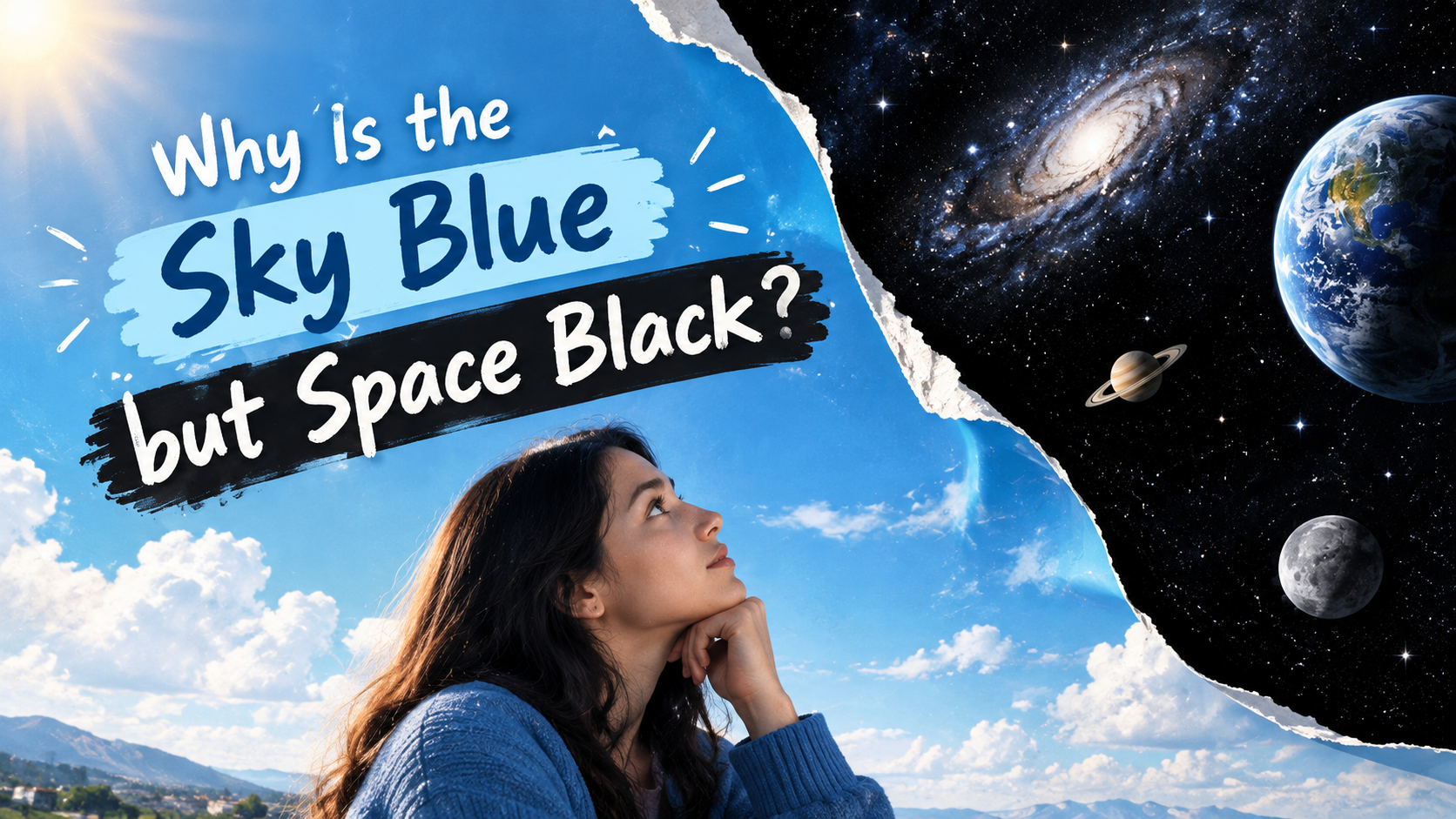
Why Is the Sky Blue but Space Black?
Look up on a clear afternoon and the sky usually appears bright blue. Look at photographs taken from space, however, and the sky around Earth looks completely black.
That can seem strange at first. After all, the Sun is shining in both places. So why does Earth have a blue sky while space looks dark?
The answer has to do with Earth's atmosphere and the way sunlight interacts with the gases around our planet.
Sunlight Is Made Up of Many Colors
Sunlight may look white when we see it coming from the Sun, but it is actually made up of many different colors.
Red, orange, yellow, green, blue, indigo, and violet are all part of visible light. Each color has a different wavelength. Red light has a longer wavelength, while blue and violet light have much shorter wavelengths.
When sunlight travels through empty space, these different colors generally continue traveling in straight lines. There is nothing around them to scatter the light in every direction.
What Happens When Sunlight Reaches Earth?
Earth is surrounded by an atmosphere made mostly of nitrogen and oxygen, along with smaller amounts of other gases.
When sunlight enters the atmosphere, it encounters these tiny gas molecules. The light can be scattered in different directions instead of continuing in one straight path.
Shorter wavelengths, particularly blue light, are scattered much more strongly than longer wavelengths such as red light. This process is known as Rayleigh scattering.
Because blue light gets scattered throughout the atmosphere, our eyes can see blue light coming from many different parts of the sky. That is why the sky appears blue even when we are not looking directly toward the Sun.
But Why Isn't the Sky Violet?
If violet light has an even shorter wavelength than blue light, you might wonder why the sky does not look violet.
There are a few reasons. The Sun produces less violet light than blue light, and our eyes are also much more sensitive to blue than violet. Some violet light is absorbed in the upper atmosphere as well.
The result is the familiar blue color that we see during the day.
Why Does Space Look Black?
Space itself is not filled with the kind of atmosphere we have on Earth.
There are particles and gas in space, but they are spread extremely thin compared with Earth's atmosphere. There are not enough molecules close together to scatter sunlight around in the same way.
If you are outside Earth's atmosphere, sunlight can travel past you without filling the surrounding sky with scattered light. Unless you are looking directly at a bright object such as the Sun or a star, the background can appear black.
That is why astronauts can see a black sky even while sunlight is shining brightly around them.
Why Do Astronauts Need a Visor?
The black appearance of space does not mean sunlight has become weak.
In fact, direct sunlight in space can be extremely intense because there is no atmosphere to filter and scatter it before it reaches an astronaut. Spacesuit visors help protect astronauts' eyes from bright sunlight and harmful radiation.
So an astronaut can have the Sun shining directly on their visor while the surrounding sky still appears completely black.
What Happens During Sunrise and Sunset?
The color of the sky changes when sunlight has to travel through more of Earth's atmosphere.
During sunrise and sunset, the Sun is low on the horizon. Its light passes through a much longer path through the atmosphere before reaching our eyes.
Much of the blue light is scattered away before the sunlight reaches us. The longer-wavelength colors, such as red and orange, are more likely to make it through.
That is why sunsets can produce warm shades of orange, red, and pink.
Why Does the Sky Look Deeper Blue at High Altitudes?
As you travel higher above Earth's surface, there is less atmosphere above you.
At high altitudes, the sky can appear darker and deeper blue because there are fewer air molecules available to scatter sunlight toward your eyes.
From a commercial airplane, for example, the sky can look noticeably darker blue than it does from the ground.
What Would Earth Look Like Without an Atmosphere?
If Earth had no atmosphere, the daytime sky would look much more like the sky seen from space.
There would be no large layer of air to scatter sunlight across the sky. The Sun would still be bright, but the background around it would remain dark.
This is one reason photographs taken on the Moon look so different from photographs taken on Earth. The Moon has an extremely thin atmosphere, so it does not create the same blue daytime sky.
A Simple Way to Think About It
Imagine shining a flashlight inside a completely empty, dark room. You can see the beam clearly only when there are dust particles, smoke, or something else in the air to scatter the light toward your eyes.
Earth's atmosphere works in a similar way. The gas molecules scatter some of the sunlight, allowing light to reach our eyes from different directions.
Space has far fewer particles, so there is much less scattered light. The result is a dark background.
So, Why Is the Sky Blue but Space Black?
The difference comes down to Earth's atmosphere.
Sunlight travels through the near-vacuum of space without being scattered very much, so space appears black. Once that sunlight reaches Earth's atmosphere, tiny gas molecules scatter the shorter blue wavelengths in many directions, giving the daytime sky its blue appearance.
It is the same sunlight. The big difference is what happens to that light along the way.
And the next time you see a blue sky, you are actually seeing the atmosphere interacting with light from a star that is about 150 million kilometers away.