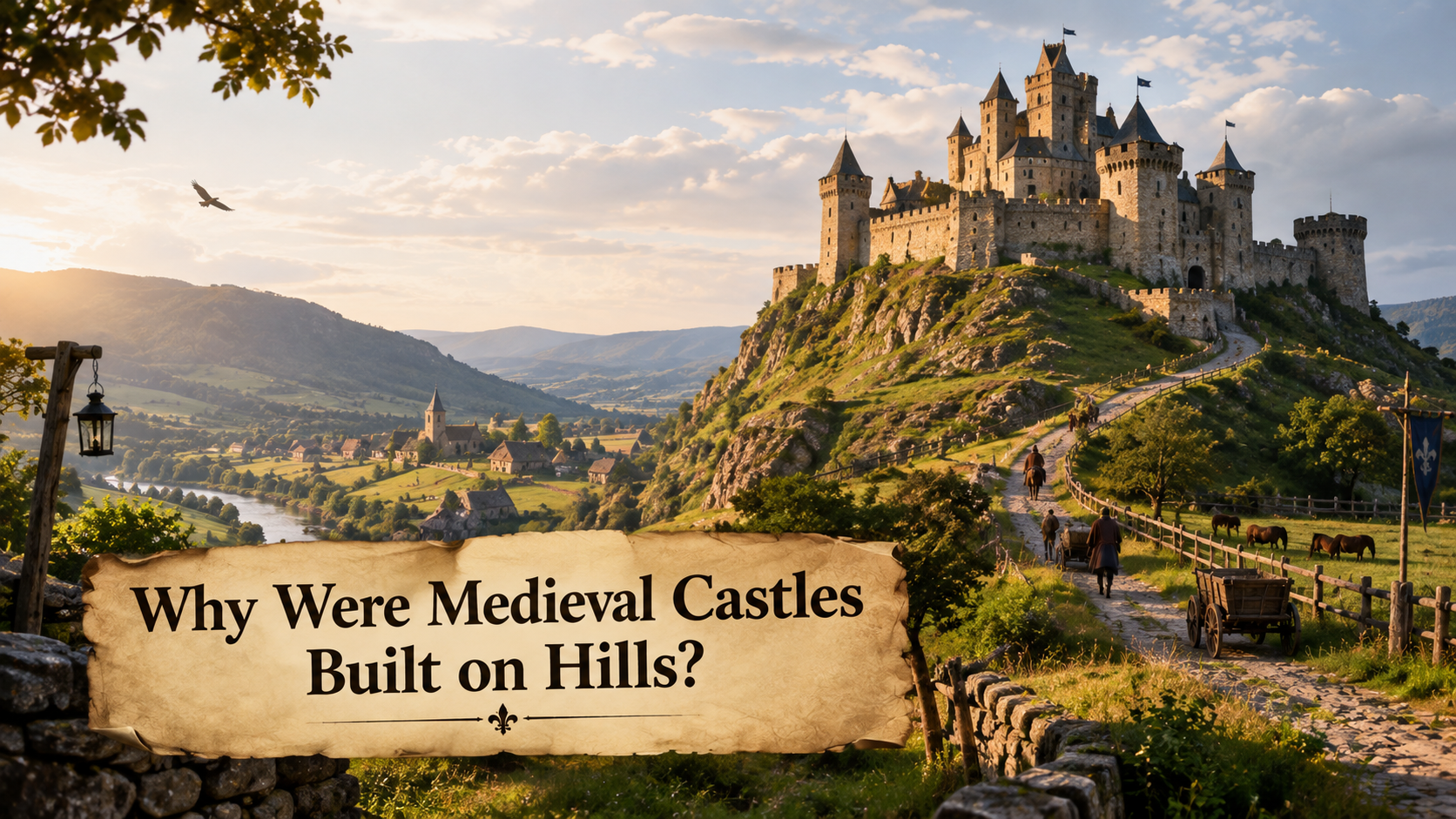
Why Were Medieval Castles Built on Hills?
When you picture a medieval castle, there is a good chance you imagine it sitting high above the surrounding countryside, with thick stone walls and towers looking down over the land below.
That position was rarely accidental.
During the Middle Ages, castles were built for protection, control, and survival. A hill or other high point could give a castle a major advantage, especially when defending it from an approaching enemy.
But height was only part of the reason. The location of a castle could affect everything from visibility and defense to transportation and control of nearby roads.
Higher Ground Made It Easier to See an Enemy
One of the simplest advantages of building a castle on a hill was visibility.
From high ground, guards could see much farther across the surrounding landscape. An approaching army, group of riders, or even a large group of travelers was easier to spot from a tower than from a building hidden among trees or on flat ground.
This gave defenders more time to prepare.
In a world without telephones, radios, or modern surveillance, seeing an approaching threat early could make a huge difference.
Attackers Had to Fight Uphill
Trying to attack a castle from below was much harder when the castle stood on a steep slope.
Soldiers carrying weapons, shields, ladders, and other equipment had to move uphill while defenders were positioned above them. The defenders could take advantage of gravity and the higher ground while attackers had to spend energy simply reaching the walls.
A steep approach could also make it difficult to move large siege equipment into position.
So the hill itself became part of the castle's defenses.
Walls Were Even More Difficult to Reach
Medieval castles often had thick walls, towers, gates, and other defensive features. Putting those structures on elevated ground added another obstacle for an attacking force.
If an enemy had to climb a steep slope before reaching the walls, the castle's defenders had more time to respond.
The exact advantage depended on the shape of the hill. A naturally steep slope could be extremely useful, while a gentle hill offered much less protection.
Some Hills Were Almost Natural Fortresses
Not every castle was built on a dramatic mountain or enormous hill. Some were placed on smaller rises in the landscape that still offered useful defensive advantages.
In some locations, the natural shape of the land did much of the work.
A castle might be positioned on a rocky outcrop, a narrow ridge, or a hill surrounded by steep slopes. Builders could then strengthen the naturally difficult terrain with walls, towers, ditches, and gates.
This could save effort compared with trying to create every defensive obstacle from scratch.
Hills Helped Defend the Castle's Main Entrance
A castle was not equally vulnerable from every direction.
Builders could choose an approach that made it difficult for attackers to reach the main gate. Roads leading toward the entrance might wind around the hill rather than heading straight up.
That mattered because the main gate was one of the most heavily defended parts of a castle. If attackers had to approach it slowly and along a predictable route, defenders had a better chance of stopping them.
Castles Were Also Built to Control the Land
Defense was important, but medieval castles were not simply giant houses designed to survive attacks.
Many were built to control important areas.
A castle overlooking a river crossing, major road, valley, harbor, or important settlement could help its occupants monitor movement through the region.
From a high position, it was easier to keep an eye on roads and surrounding settlements. In some cases, the castle's presence itself was a reminder of who controlled the area.
Rivers and Roads Could Be Watched From Above
Transportation in medieval Europe depended heavily on roads, rivers, and passes through difficult terrain.
A castle positioned above one of these routes could be strategically valuable. Travelers, merchants, soldiers, and messengers passing through the area might all come within sight of the castle.
Some castles therefore had a purpose beyond defending themselves. Their location helped their owners influence what happened in the surrounding region.
Not Every Castle Was Built on a Hill
It is worth remembering that medieval castles were not always located on high ground.
Some were built on flat land, near rivers, inside towns, or in other locations where different advantages mattered more.
In areas with little natural high ground, builders could rely more heavily on artificial defenses such as moats, earthworks, walls, towers, and fortified gates.
The best location depended on what the castle was supposed to protect and the landscape around it.
Why Build on a Hill if It Made Construction Harder?
Building a large stone castle was already an enormous project. Constructing one on a hill could create additional problems.
Materials had to be transported uphill, foundations had to be prepared on uneven ground, and workers had to deal with difficult terrain.
Even so, the defensive advantages could make the extra effort worthwhile.
A good location could reduce the amount of defensive work needed elsewhere because the landscape itself became part of the fortification.
Hills Could Also Make Siege Attacks Harder
During a siege, an attacking army might try to surround a castle and prevent supplies from reaching it. Attackers could also attempt to damage the walls or force their way through a gate.
A castle on elevated ground could complicate these efforts.
Moving heavy equipment uphill was difficult, and attackers had to work from a position that was often exposed to defenders above them. The exact effectiveness depended on the castle's design, the terrain, and the resources available to both sides.
A hill did not make a castle impossible to capture, but it could make the job considerably more difficult.
The Castle Had to Work With the Landscape
Medieval castle builders did not simply look for the highest piece of land they could find.
They had to think about water supplies, food, roads, nearby settlements, farmland, trade routes, and the possibility of attack.
A castle that was extremely high but difficult to supply might be less useful than one on a lower hill near an important road or river.
The landscape had to work with the castle rather than against it.
So Why Were Medieval Castles Built on Hills?
High ground offered several practical advantages at the same time.
It gave defenders a wider view of the surrounding area, forced attackers to fight uphill, made the walls harder to reach, and could help the castle control important roads, rivers, and settlements.
Perhaps the most interesting part is that the hill itself became part of the castle's defense. Instead of relying only on stone walls and towers, medieval builders could use the natural landscape to make an attack more difficult.
That is why so many medieval castles still appear to dominate the landscape today. Their builders were not only constructing fortifications; they were choosing a position where the land could help defend them.