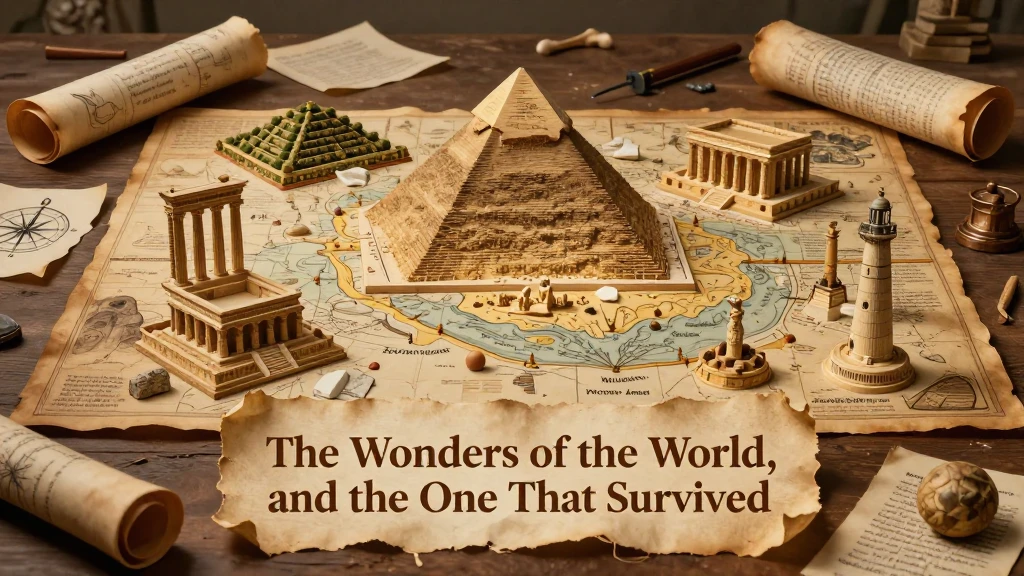
The Wonders of the World, and the One That Survived
The seven wonders of the ancient world were essentially a tourist list, compiled by Greek writers for Greek travellers. Six of them are gone — lost to earthquakes, fires, and the slow theft of useful stone.
The Seven Ancient Wonders
- The Great Pyramid of Giza, Egypt — the only one still standing.
- The Hanging Gardens of Babylon — described by ancient writers, but no trace has ever been found, and some historians doubt they existed at all.
- The Temple of Artemis at Ephesus — burned down in 356 BC by a man who wanted his name remembered. The authorities tried to ban anyone from speaking it.
- The Statue of Zeus at Olympia — a giant seated figure of gold and ivory by the sculptor Phidias.
- The Mausoleum at Halicarnassus — the tomb of Mausolus, a Persian governor. His name gave us the word "mausoleum".
- The Colossus of Rhodes — a huge bronze statue of the sun god Helios. It stood for only about 50 years before an earthquake toppled it, and it almost certainly did not straddle the harbour as later pictures show.
- The Lighthouse of Alexandria — built on the island of Pharos. In several languages, the word for lighthouse still comes from that name.
The Survivor
The Great Pyramid of Giza is also, by a wide margin, the oldest thing on the list. It was already some two thousand years old when the Colossus of Rhodes was built. It remained the tallest structure made by humans for around 3,800 years, a record no building has come close to matching since.
The New Seven Wonders
In 2007, a worldwide public vote chose seven "New Wonders of the World": the Great Wall of China, Petra in Jordan, Christ the Redeemer in Rio de Janeiro, Machu Picchu in Peru, Chichén Itzá in Mexico, the Colosseum in Rome and the Taj Mahal in India. The Great Pyramid was given honorary status.
The Myths Worth Killing
The Great Wall of China is not visible from space with the naked eye. It is long, but it is narrow and the same colour as the ground around it. Astronauts have said so repeatedly; the myth refuses to die. It is also not one wall but many, built and rebuilt over two thousand years, with a total length of more than 20,000 kilometres including all its branches.
The Eiffel Tower was built for the 1889 World's Fair and was meant to be temporary. Parisian artists and writers publicly loathed it. It survived largely because it turned out to be useful as a radio transmitter. At 330 metres, it was the tallest structure in the world until 1930.
The Leaning Tower of Pisa did not lean by design. It began tilting during construction in the 12th century because the ground beneath one side was too soft — and builders kept going anyway, which is why it is also subtly curved. Engineers finally stabilised it in 2001.
Monuments to Grief and Power
The Taj Mahal is not a palace. It is a tomb — a mausoleum built by the Mughal emperor Shah Jahan for his wife Mumtaz Mahal, who died in childbirth in 1631. Twenty thousand or so workers, around twenty years, and a building whose entire purpose is to say that someone was loved.
The Colosseum, by contrast, held around fifty thousand spectators and was built for spectacle and control. It opened in AD 80 with games said to have lasted 100 days.
Petra, the "Rose City" carved into pink sandstone cliffs in Jordan, was the capital of the Nabataean kingdom. It was largely unknown to Europeans until a Swiss explorer reached it in 1812.
Machu Picchu, high in the Peruvian Andes, was built in the fifteenth century and — crucially for the quiz round — was never found by the Spanish.
The Gift
The Statue of Liberty was a gift from France, dedicated in 1886. It was designed by Frédéric Auguste Bartholdi, and its internal iron framework was engineered by Gustave Eiffel — the same Eiffel as the tower. It arrived in crates. She is green because copper oxidises; she was originally the colour of a new penny.
Every one of these has a fact attached that most people get wrong. That is what makes them such reliable quiz material. Test yourself in the free History quiz or Geography quiz.